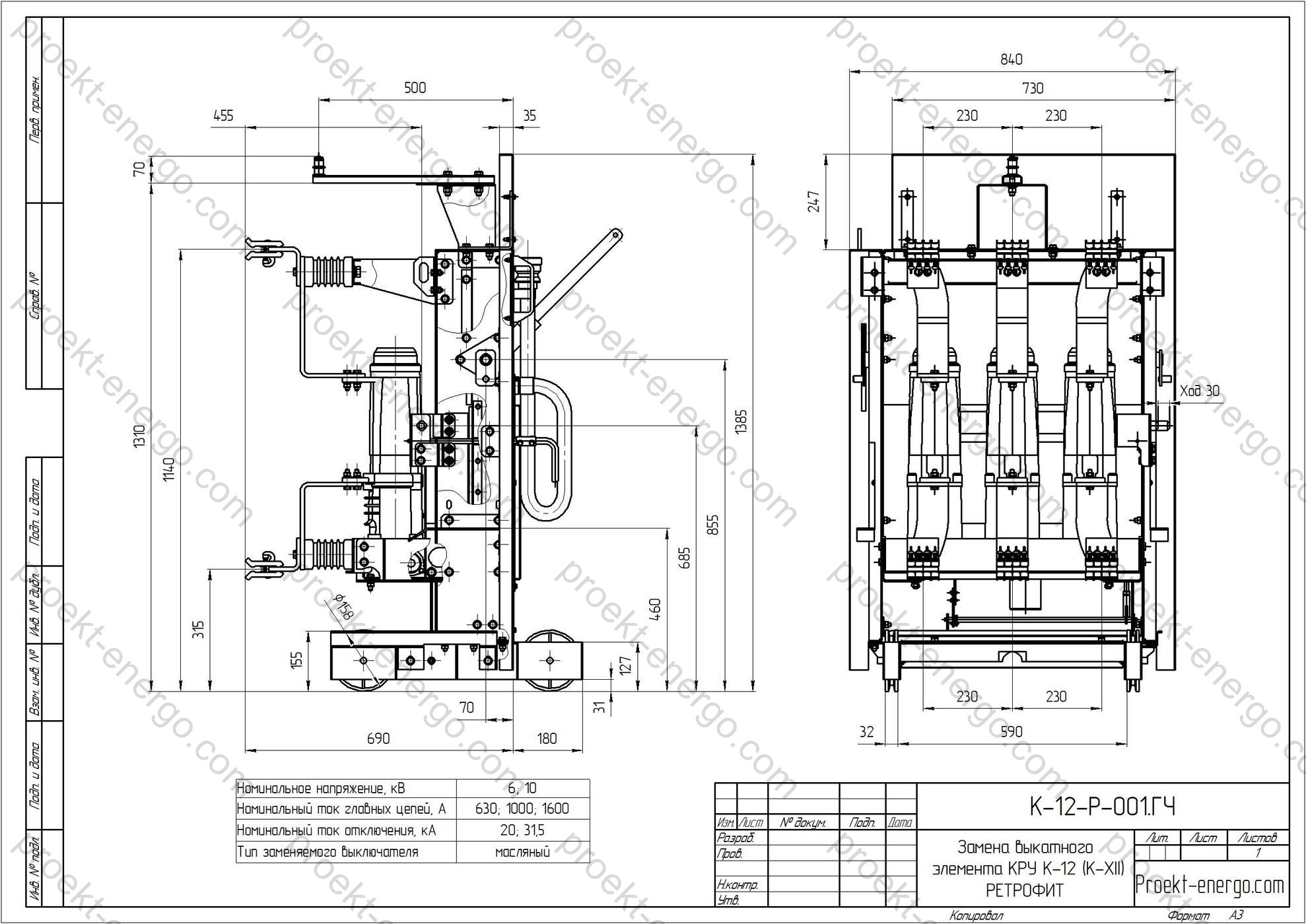
KRU K-12 (K-XII) – withdrawable unit replacement (retrofit)
Retrofit of the withdrawable unit for KRU K-12 (K-XII) is an engineering solution to extend the service life of 6–10 kV medium-voltage switchgear without full replacement of cubicles and busbar systems. We replace oil circuit breakers with modern vacuum or SF6 devices, adapt mechanical and electrical interfaces, and upgrade interlocks, the shutter mechanism, and secondary circuits. This approach reduces CAPEX/OPEX, improves safety and reliability, and significantly shortens equipment downtime during maintenance. Key search queries: “KRU K-12 retrofit”, “K-XII withdrawable unit replacement”, “oil CB to vacuum replacement”, “OneFit-class modules for MV switchgear”, “eco-retrofit MV switchgear”, “LSC2B-PM”, “IAC AFLR”.
Purpose and application
The primary goal of retrofitting KRU K-12 (K-XII) is to replace an obsolete switching device (minimum-oil/air/oil circuit breaker) with a modern vacuum or SF6 circuit breaker with a built-in spring-stored or electromagnetic actuator, while keeping the existing cubicle body, busbars, cable terminations, and inter-panel connections. The solution targets primary and secondary power distribution at industrial substations (metals, oil & gas, mining, chemical), utility networks (6–10 kV switching stations/substations), transport and municipal infrastructure (metro, railway traction, water utilities, district heating), as well as data centers and large commercial facilities.
Retrofitting is reasonable when:
– the oil circuit breaker has exhausted its service life, leaks/depressurization occur, and oil-handling costs are rising;
– higher fire and electrical safety requirements are in force and arc-flash incident energy must be reduced;
– maintenance time must be shortened and serviceability increased: taking a feeder out/in is reduced to a single shift;
– modernization of protection and control is planned (migration to microprocessor IEDs, ATS, load-shedding schemes, telecontrol) with preservation of the power section;
– fleet unification of breakers is required (a single platform of E2/M2 vacuum devices with predictable maintenance);
– budgets are limited and/or a full switchroom rebuild with long outage is not feasible.
A completed retrofit raises the overall availability of KRU/KSO, improves fault tolerance, and expands functionality: built-in diagnostics (operation counter, spring life monitoring, contact temperature monitoring), position indication “disconnected/test/service/earthing switch”, arc-flash protection integration and high-speed tripping. A properly designed modular approach enables phased modernization - 1–2 feeders per outage - without impacting adjacent panels and without re-aligning busbar bridges.
Technical data
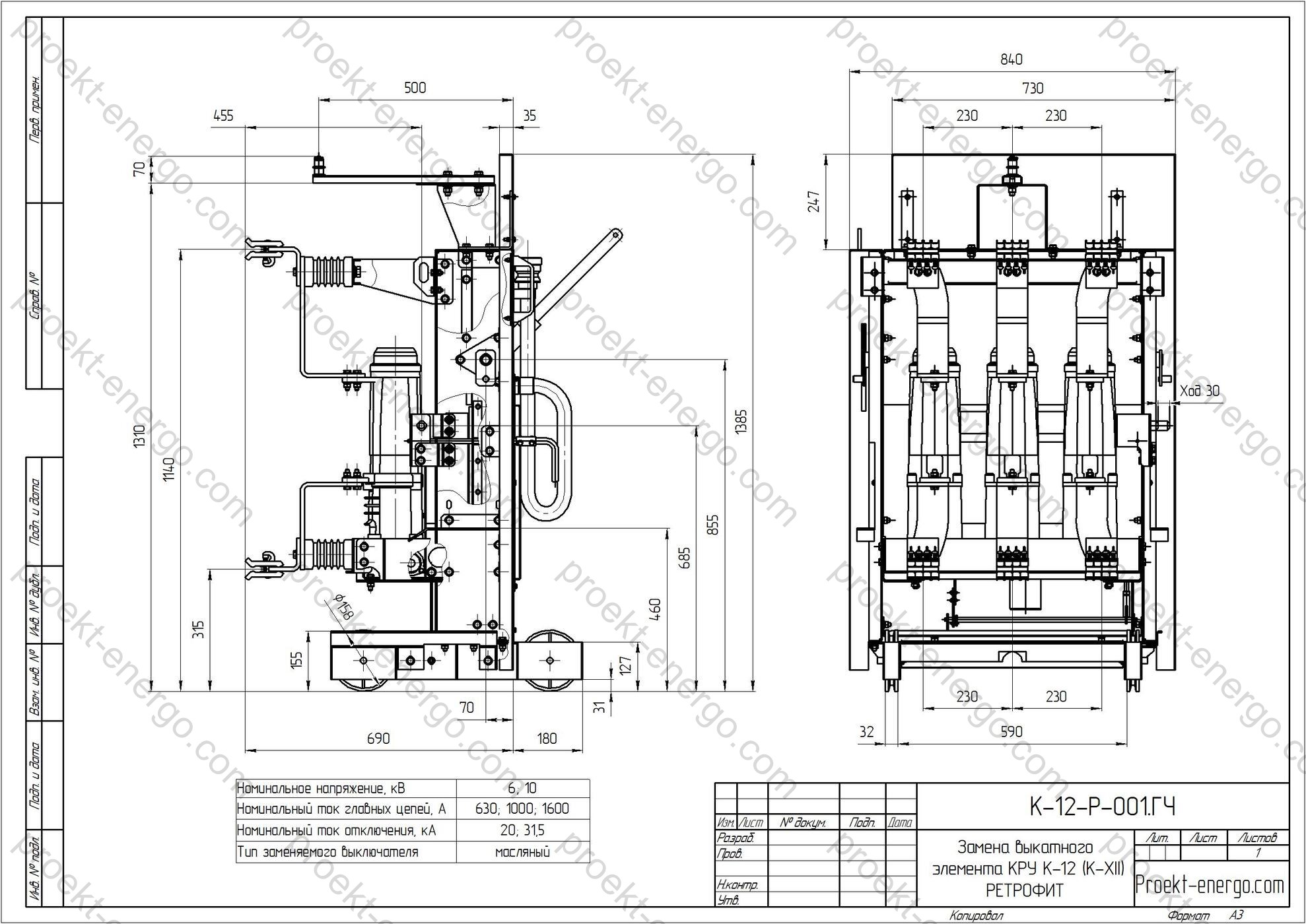
Below are typical parameters of the retrofit solution for KRU K-12 (K-XII). Exact values depend on the selected breaker, current-carrying parts, and service conditions; they are confirmed by calculations and test reports.
| Parameter | Typical value | Notes |
|---|---|---|
| Rated voltage | 6; 10; 12 kV | Selection per network class; compatible with K-12 insulation clearances |
| Rated current of withdrawable unit | 630…3150 A | Depends on cross-section of conductors and heat dissipation |
| Short-time withstand current (3-ph fault) | 20…40 kA (1 s/3 s) | Per calculated Ik and Ipeak up to ~2.5×Ik |
| Power-frequency withstand, 1 min (50 Hz) | 20/28 kV (ph-ph/ph-earth) | For 6/10 kV class; depends on applied insulation |
| Lightning impulse withstand (LI, 1.2/50 µs) | 60/75 kV | Typical for 6/10 kV cubicles |
| Endurance class of breaker | E2/M2 | Enhanced electrical/mechanical endurance |
| Operating cycle | O-CO-CO | Standard for fast trip/reclose sequences |
| Degree of protection (enclosure) | Front IP2X…IP4X; compartments - per design | Defined by cubicle design and ventilation |
| Climatic category | Per EN/IEC 60721-3-3/-3-4 | Options from -45…-60 °C; upper limit up to +40 °C |
| Installation altitude | up to 1000 m without derating | Above - per calculation/derating |
| LSC category/partitions | LSC2B, PM/PI (project-specific) | Access to compartments with live busbars/cables |
| Internal arc classification (IAC) | AFL/AFLR 20–31.5 kA, 1 s* | *Within the structural capabilities of the K-12 cubicle |
| Compatibility | K-12 (K-XII) interfaces | Preservation of busbars, foundations, cable entries |
| Safety options | Arc-flash protection, temperature sensors, pressure relief | As per cubicle survey |
| Withdrawable unit mass | ≈ 120…250 kg | Depends on selected breaker and configuration |
Service conditions
Retrofit solutions are engineered for the site’s real conditions and climatic categories per EN/IEC 60721-3-3/-3-4. Typical parameters: installation altitude up to 1000 m a.s.l. (no derating), relative humidity up to 95% (non-condensing), location categories according to the KRU K-12 operating documentation and the required climatic category. On request: configurations per EN/IEC 60721-3-3/-3-4 with operating temperatures from -45…-60 °C to +40 °C, dust/moisture protection per IP code (front IP2X…IP4X considering ventilation perforations), enhanced corrosion resistance (hot-dip galvanizing, powder coatings 80–120 µm, stainless hardware), and seismic compliance confirmed by calculations and bench tests.
Special focus on:
• thermal performance - recalculation of current-carrying parts and contacts for rated and overload currents, overheat verification per IEC methods, optimization of breaker-compartment ventilation, spark-/heat-resistant shields near assemblies;
• insulation - materials with elevated tracking resistance CTI ≥ 600, verification of clearance and creepage for 6/10/12 kV, shielding of critical areas, anti-static channels in the shutter mechanism;
• mechanics and interlocks - preservation of K-12 kinematics with replacement of worn parts, low-friction guides, anti-freeze jamming protection at low temperatures, fail-safe access logic to compartments with the earthing switch engaged.
Layout and design solutions
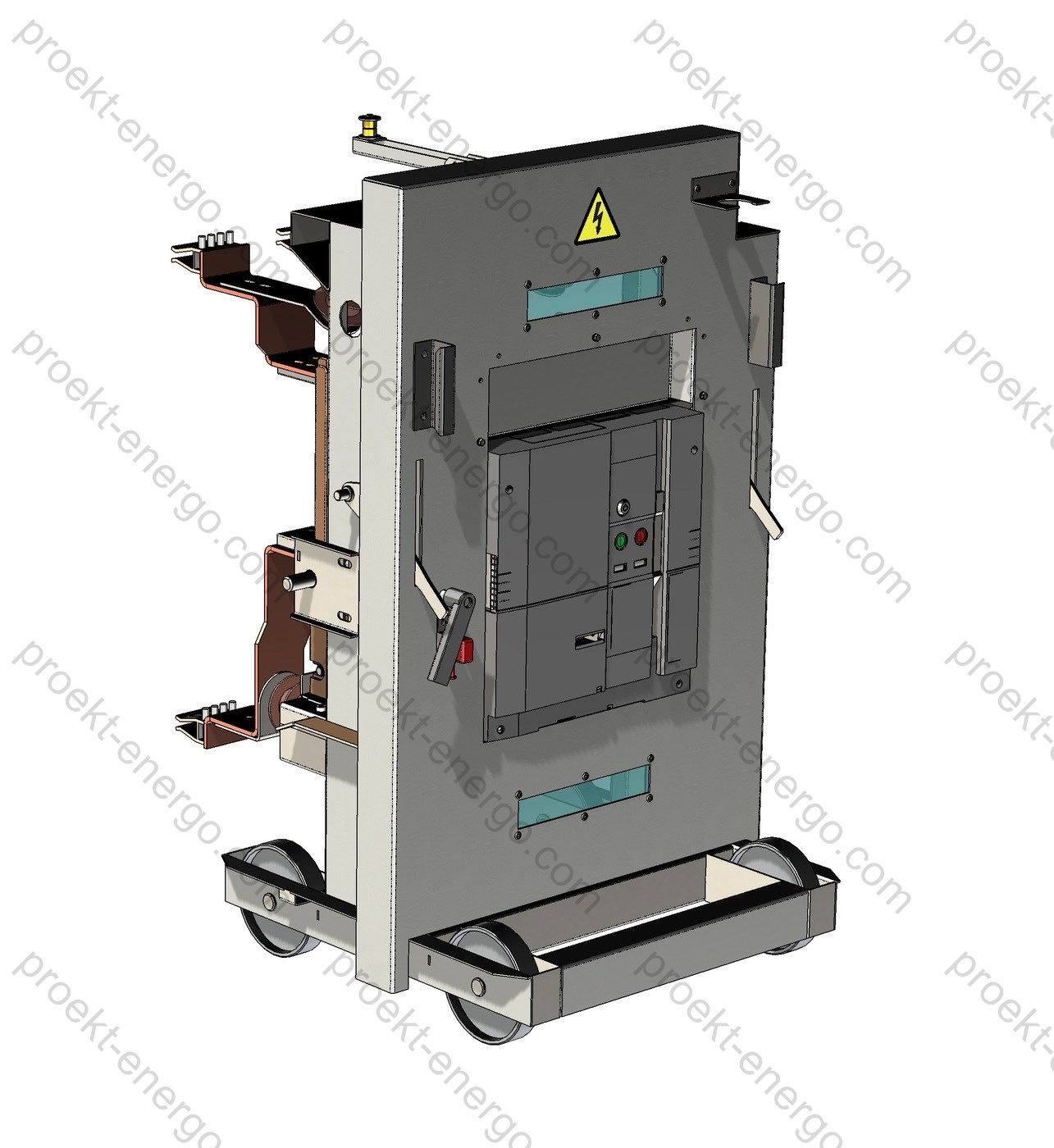
The K-12 withdrawable-unit retrofit is delivered as a set of adaptation assemblies and a new withdrawable truck with a breaker. The relative position of assemblies and mechanism strokes are retained within the standard cubicle; primary and secondary interfaces are brought to the typical dimensions and logic of native interlocks. The design ensures repeatability and factory readiness, which shortens commissioning time and reduces on-site risks.
- New withdrawable unit with a vacuum or SF6 breaker (E2/M2 endurance), unified carriage, energy-storage drive, and position mechanisms “Disconnected/Test/Service”.
- Contact-system adaptation: transition “tulips”, alignment of moving/fixed contacts, restoration or replacement of contact fingers with higher spring force; wear-resistant guides with precise geometry and anti-skew stops.
- Shutter mechanism with automatic phase-window closing upon withdrawal, mechanical indicators, and visual position check through door viewports.
- Earthing-switch drive (manual/motor) with mechanical and electrical interlocks preventing ES closing with the breaker ON; ON/OFF indication, provisions for limit switches.
- Secondary interfaces: unified plug-in connectors or terminal blocks; looms marked per IEC 81346, jumper tables, signal addressing; optional provisions for temperature/arc sensors.
- Protection & control integration: hardwired signals “READY”, “POSITION”, “ALARM”, “SWITCHING LIFE”; provisions for arc-flash protection (fiber-optic/point sensors), fast-trip algorithms.
- Improved arc-resistance of the cubicle: depending on K-12 structure - reinforced doors, directed pressure-relief ducting, rupture-type flaps, fire-rated cable glands.
Retrofit options comparison
| Option | Scope | Pros | Considerations |
|---|---|---|---|
| Adaptation kit for the existing truck | New breaker + transition adapters, interlock rework, contact alignment, carriage overhaul | Lowest budget, maximum reuse of existing parts | Labor-intensive assembly and alignment; depends on the condition of carriage and guides |
| Full replacement of the withdrawable unit | New withdrawable block (interface/size-compatible), shutter mechanism, secondary connector set | Shorter schedule, predictable outcomes, old unit kept as a spare | Requires precise compatibility check to cubicle tolerances |
| Factory-built module (OneFit/ECOFIT class) | Factory module: breaker, interlocks, shutters, primary adapters; type-tested | Maximum unification, improved insulation/thermal margins, fast energization | Higher cost; fixed module configuration |
“Vacuum vs. oil” comparison (retrofit benefits)
| Criterion | Oil circuit breaker | Vacuum/SF6 circuit breaker | Retrofit effect |
|---|---|---|---|
| Maintenance | Regular oil-management tasks, leakage risks | Sealed-for-life interrupters, simplified maintenance schedule | Lower OPEX, higher availability, greener footprint |
| Switching endurance | Limited; degrades over time | E2/M2 classes; stable interrupting performance | Longer life, predictable short-circuit interruption |
| Personnel safety | Stricter fire-safety measures; risk of oil release | Compatible with IAC solutions; arc-flash protection integration | Lower incident energy; compliance with modern practice |
| Modernization time | Often requires longer outage | Turnkey modular replacement | Reduced downtime; phased feeder replacement |
| P&C integration | Limited, often hard-wired logic | Full compatibility with IEDs; diagnostics | Flexible settings; remote monitoring |
Safety
The retrofit targets today’s safety level for personnel and equipment. Mechanical and electrical interlocks prevent incorrect operations; doors are interlocked with breaker/earthing-switch position; shutter partitions and a procedural key-logic are applied. On demand, arc-flash protection with fiber-optic and/or point sensors is integrated; high-speed outputs and compartment-selectivity are provided; typical command-generation time is a few milliseconds, and the full “detection-trip” cycle with fast drives is in the tens of milliseconds. Where structure permits, solutions include directed gas relief (flaps/ducts), reinforced leaves, higher-temperature-resistant seals, and fire-rated cable glands. Additional options: temperature sensors on contact joints and busbars, and operation-count monitors.
Manufacturing options
- Economy: adaptation kit for a new breaker with minimal changes to the carriage and cubicle; applicable when guides, contacts, and interlocks are in good condition.
- Standard: delivery of a new withdrawable unit assembled and compatible with K-12 by interface dimensions, operating sequence, and interlock kinematics; set of updated shutters and an earthing-switch drive.
- Premium (factory-built module): OneFit/ECOFIT-class module with type tests, single datasheet, integrated current/voltage sensors, and provisions for modern protection IEDs.
- Options: door and seal replacement, migration to unified secondary connectors, installing metering/control CTs/VTs, replacement of insulators and busbar take-offs, integration of arc-flash protection and condition monitoring, provisions for IoT telemetry (Modbus/IEC 61850).
Standards compliance
Design and manufacturing of retrofit kits are tied to applicable norms. For 6–10 kV MV switchgear, compliance is usually confirmed to the following (final scope per SOW and layout):
- IEC 62271-200 - metal-enclosed switchgear up to 52 kV (requirements for cubicles, compartments, IAC, LSC).
- IEC 62271-100 - AC circuit breakers (E/M endurance classes, switching capability, dielectric/mechanical tests).
- IEC 62271-102 - earthing switches and disconnectors (strength, interlock logic, operation sequence checks).
- IEC 60529 - degrees of protection (IP code for fronts/compartments after modernization).
- IEC 60068 (series) - climatic/vibration tests of parts and modules (as required).
- EN/IEC 60721-3-3 and EN/IEC 60721-3-4 - classification of environmental conditions for stationary use/outdoor exposure (climatic categories for application in the target region).
Partnership with contractors
We are open to cooperation with electrical OEMs, machine-building plants, investors, and EPC contractors to organize serial production of K-12 (K-XII) retrofit kits at your facilities. Cooperation models include: documentation licensing, delivery of the “core” (withdrawable unit + adapter set), localization of welding/machining, incoming/outgoing quality control via checklists, training of assemblers and commissioning engineers, joint FAT/SAT. For protection-relay contractors, we provide ready secondary wiring diagrams, panel templates, cable/connector sets, and typical setting templates. White-label delivery is possible subject to quality requirements and test protocols.
Deliverables
After aligning the questionnaire and K-12 measurements, we provide a documentation set: overall and interface drawings of the withdrawable unit and adapters, BOMs, single-line/schematic/connection diagrams, jumper and addressing tables, 3D models (STEP/Parasolid), DXF/DWG for machining, routing cards, test program and methods (TPM), installation/operation manual, datasheets and records. On request - CAM data, laser cutting/bending files, thermal-calculation reports, and type-test protocols of modules within reference cubicles.
Implementation process
- K-12 cubicle survey: measurements, photo log, assessment of guides, contacts, insulation, busbars, and doors; capturing interface “masks” and tolerances.
- Design: 3D model development of the withdrawable unit and adapters, thermal/dielectric analysis, interlock mechanics calculation, issue of drawings and routing sheets.
- Manufacturing: machining, powder coating, assembly, straightening, marking; incoming material control and outgoing unit control per checklists.
- Type and routine tests: dielectric checks, functional tests of drives and interlocks, insulation and circuit-resistance checks, arc-event simulations (when AD system is used).
- Site installation and commissioning: removal of the old device, installation of the new withdrawable unit, alignment, secondary wiring, relay setting, staff training.
- Handover and support: delivery of datasheets/protocols, O&M recommendations, spare-parts and service kits, after-sales support.
Project economics
Compared with full switchgear replacement, retrofit typically saves 30–60% of capital costs by retaining cubicles, busbars, cable routes, and civil works. Feeder downtime is additionally reduced (from days/hours to a single shift), and operating costs decrease thanks to elimination of oil handling and longer life of vacuum interrupters. Fleet unification reduces spare stock, speeds recovery after faults, and simplifies staff training. Payback often falls within 12–24 months due to avoided unplanned outages and reduced scheduled maintenance.
Why work with us
- No need to maintain a large senior engineering team - you receive a complete documentation set for the product that a mid-level engineer can work with.
- No need to build pilot units - our experience and a library of proven assemblies allow you to go into series right after documentation release and reference kit assembly.
- Working to our documentation, your staff will get guidance on all nuances of K-12 (K-XII) withdrawable-unit replacement, including contact alignment, interlock verification, thermal calculation, and TPM.
- Option to supply the retrofit “core” (withdrawable unit + adapters) or a turnkey kit with commissioning, plus FAT/SAT support.
For more information on KRU K-12 (K-XII) withdrawable unit replacement (retrofit), please contact: inbox@proekt-energo.com
PDF - Download the technical information for KRU K-12 (K-XII) withdrawable unit replacement (retrofit)
Documents