KSO-423 “Omega” Single-front Medium-Voltage Metal-Enclosed Switchgear
Purpose and application
KSO-423 “Omega” are modular single-front switchgear cubicles (metal-enclosed, air-insulated – AIS) for receiving, distributing, and switching three-phase AC power at 50 Hz for 6–10 kV systems. The series is intended for networks with isolated or effectively earthed neutrals at distribution utilities and industrial power facilities. Typical applications include indoor AIS of packaged transformer substations, industrial substations, plant auxiliary switchgear of power stations, and power centers for transport, logistics, and municipal infrastructure. The cubicles are supplied both for installation in permanent indoor substations and for integration into factory-built modular blocks, reducing commissioning time and total installed cost.
Functionally, KSO-423 “Omega” covers incomer and bus-section panels with a circuit-breaker, feeder panels, transformer feeders, metering and measuring panels, and-optionally-power-factor correction cubicles. Single-front service provides access to all controls and indications from the front, enabling rows of cubicles to be arranged along a wall and making efficient use of the switchroom footprint. Unified interfaces and a standardized busbar system allow easy scaling and adaptation to supply schemes of different reliability categories.
Service conditions
Base environmental category - EN/IEC 60721-3-3 (indoor, weather-protected; replaces GOST 15150 U3). Project-specific variants for other location categories (e.g., cold climate, tropical, enhanced corrosion resistance) are available with due account of temperature/humidity ranges, site altitude, and corrosion category. The typical degree of enclosure protection is IP31 per IEC 60529; local increases of IP for individual compartments can be provided subject to thermal and ventilation constraints.
Rated voltage series follows international practice: 6 kV (highest system voltage 7.2 kV) and 10 kV (highest system voltage 12 kV). Insulation levels and air clearances are selected to withstand lightning and switching overvoltages; electrodynamic forces and thermal effects under short-circuit currents are considered in line with the specified thermal and peak withstand ratings.
Layout and construction
The “Omega” series uses three segregated compartments - busbar, apparatus, and cable - improving fault containment, serviceability, and safety. Compactness is achieved by arranging primary devices transverse to the main busbars, reducing depth without compromising dielectric performance. The busbar system is formed by consecutively joined copper bar segments on post insulators; provisions are made for through-bushings or bus partitions to enhance segregation and enable safe section coupling. For “two-row” halls, bus bridges or cable links between sections are available.
The apparatus compartment is withdrawable: the vacuum circuit-breaker, current transformers, and, where required, fuse blocks or combined modules are mounted on draw-out platforms. This accelerates inspection and replacement and allows maintenance with the door closed. The cable compartment is primarily arranged for bottom entry, with top entry available on request; supports and terminals are provided for temperature sensors at cable lugs, fixing of armoured cables, and provision for test plugs. The low-voltage compartment houses digital protection & control IEDs, AR/AR (ATS/AR), metering devices, terminal rows, RTU/telecontrol equipment, and auxiliary power; wiring is routed in an integrated cable duct with spare capacity for upgrades.
Enclosures are manufactured in two technological variants: a welded steel frame with powder coating (high rigidity and impact resistance) and a non-welded enclosure made of hot-dip coated steel (Z, ZA/AZ systems) to EN 10346 with bolted/riveted joints. The latter provides enhanced corrosion resistance and stable geometry in series production; coating type is selected to meet service-life and site corrosion requirements. Front doors use reinforced multi-point latching to improve resistance to arc-pressure surges and vibration.
A front-door mimic with LED indication shows device and circuit states. Built-in internal lighting (lamp holder and socket for a portable lamp with a front-mounted switch) enables routine work without de-energizing the switchgear; lamp replacement is safe and does not require removing voltage from primary or auxiliary circuits. A voltage-presence indication system (VDIS) with interface for portable detectors can be integrated into the interlocking logic as specified.
Safety and interlocking
KSO-423 “Omega” is engineered for operational safety. All circuit-breaker operations are performed with the door closed. A system of mechanical and electrical interlocks prevents hazardous actions: disconnector operation blocked with the breaker closed; earthing-switch closing blocked with the disconnector/breaker closed; racking blocked with the breaker closed; MV-compartment doors locked unless the earthing switch is closed. Trapped-key interlocking between panels/sections is available for procedures requiring coordinated actions.
Per IEC 62271-200, continuity categories LSC (e.g., LSC2A/LSC2B) and partition classes PM/PI are applied. When equipped with arc-handling measures (gas relief, reinforced hinges/latches, arc sensors), typical configurations can be type-tested for Internal Arc Classification (IAC), e.g., AFL/AFLR, providing personnel protection for the selected accessibility.
Versions and options
- Main switching device. Medium-voltage vacuum circuit-breakers per IEC 62271-100 with interrupting ratings coordinated to calculated short-circuit levels and protection settings. Load-break switches and contactors (IEC 62271-106) can be used for special feeders; “circuit-breaker–fuse” combinations (IEC 62271-105) are available for specific applications.
- Disconnectors and earthing switches. Devices per IEC 62271-102 with required mechanical/dynamic categories; bus-section disconnectors and bypass circuits can be provided for maintenance modes.
- Protection, automation, and telecontrol. Digital IEDs for line/transformer/section protection, autoreclose/automatic transfer, and special schemes; integration via IEC 60870-5-104/IEC 61850, power-quality data export, and connection to local/upper-level SCADA.
- Measurement and metering. CTs/VTs to the IEC 61869 series with required accuracy classes, commercial/technical metering, and power-quality panels.
- Condition monitoring. Temperature sensors at cable lugs and busbars, arc-flash sensors, breaker operation counters, partial-discharge sensors - integrated into a predictive diagnostics system.
- Enclosure & environment. Dual-layer powder coating or hot-dip Z/ZA/AZ coatings per EN 10346; seals, cable glands, and fire-stopping to the specified fire-safety class; seismic calculation/testing per the required category.
- Cable infrastructure. Support for cables to IEC 60502-2 (6–30 kV) with termination kits and test provisions; bus bridges and cable links between sections.
Typical configurations
Based on standardized schemes, the following arrangements are typical: “incomer - section - feeder”, “dual incomers with ATS”, “incomer - transformer - feeder”, “incomer - section - section - feeders”, etc. For brownfield retrofits, transition panels and mechanical-interface compatibility are available. Depending on project needs, LSC categories up to LSC2B and PM (metal) or PI (insulating) partitions can be applied, allowing maintenance of an outgoing feeder without de-energizing adjacent feeders (within the selected category). Cable testing on feeder panels is supported via standard test plugs in the cable compartment.
Engaging contractors, switchgear manufacturers, and investors
We offer flexible cooperation models for localization and series production of KSO-423 “Omega”: supply of metal kits (enclosures, doors, draw-out trucks, busbar assemblies), licensing of shop documentation, outsourcing of harnesses and mounting panels, support of type/qualification tests (incl. internal-arc and functional safety), and staff training. For investors and manufacturing sites, a low-CAPEX production roadmap is available: adapting drawings to existing paint/galvanizing lines, fastener and hardware selection, routing sheets, quality plans (IQC/OQC), and incoming-inspection procedures for purchased items.
Documents
- Tender package: single-line diagrams, equipment lists, data sheets, standards-compliance matrices, 3D visuals, and an explanatory note with effort estimate, delivery schedule, risk matrix, and mandatory test list.
- Manufacturing (shop) documentation: enclosure and assembly drawings, BOMs, primary/secondary schematics, cable schedules, purchased-parts lists, routing sheets. Formats - DWG/DXF, STEP/Parasolid; models - for AutoCAD, SolidWorks, Inventor.
- Interlocking logic and safety: inter-panel and intra-panel algorithms; condition tables for close/open/earth/rack-out/access; VDIS and arc-flash integration; safe-switching instructions for operators.
- Commissioning & O&M: insulation-test programs, secondary-circuit checks, P&C settings, FAT/SAT protocols, maintenance regulations, torque charts, and lists of control measurements and diagnostic tests.
Compliance with standards
Design, manufacturing, and testing of KSO-423 “Omega” follow the requirements of the standards below (as applicable to the selected configuration and devices):
- IEC 62271-200 - AC metal-enclosed switchgear above 1 kV up to and including 52 kV (LSC categories, PM/PI partitions, internal-arc classification IAC).
- IEC 62271-1 - Common specifications for high-voltage switchgear and controlgear (consolidated edition).
- IEC 62271-100 - AC circuit-breakers for MV (2021 + Amd. 1:2024).
- IEC 62271-102 - Disconnectors and earthing switches (2018 + Amd. 1:2022).
- IEC 62271-105 - Combined “circuit-breaker–fuse” functional units.
- IEC 62271-106 - Contactors and motor-starters above 1 kV.
- IEC 61869-2 - Instrument transformers - Additional requirements for CTs.
- IEC 60038 - Standard voltages (2009 + Amd. 1:2021).
- EN/IEC 60721-3-3 - Environmental conditions for stationary use in weather-protected locations (replaces GOST 15150 U3 for climatic category); IEC 60529 - Degrees of protection (IP code).
- EN 10346 - Continuously hot-dip coated steel flat products (Z/ZA/AZ/AS/ZM) for corrosion-resistant enclosure versions.
Technical data
| Rated voltage, kV | 6; 10 |
| Highest system voltage, kV | 7.2; 12 |
| Rated current of main circuits, A | 630; 1250 |
| Rated busbar current, A | 630; 1250 |
| Thermal short-time withstand current (3 s), kA | 20 |
| Peak withstand current (1 s), kA | 51 |
| Rated fuse current, A | 200 |
| Breaking capacity of 200 A fuses, kA | 20 |
| Environmental category (replaces GOST 15150 U3) | EN/IEC 60721-3-3 |
| Degree of protection | IP31 (IEC 60529) |
| Overall dimensions, mm - width - depth - height |
300–750 840 2010–2235 |
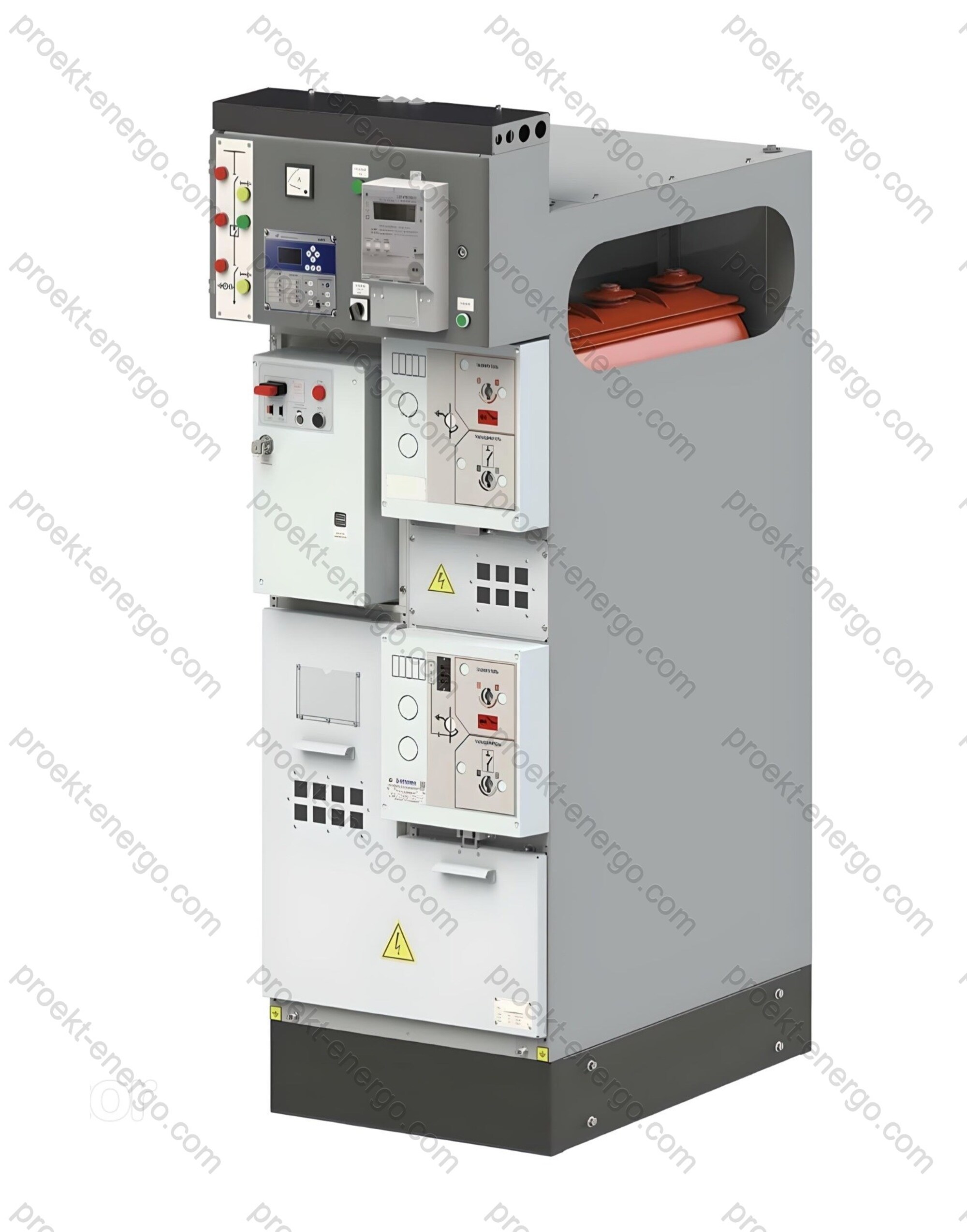
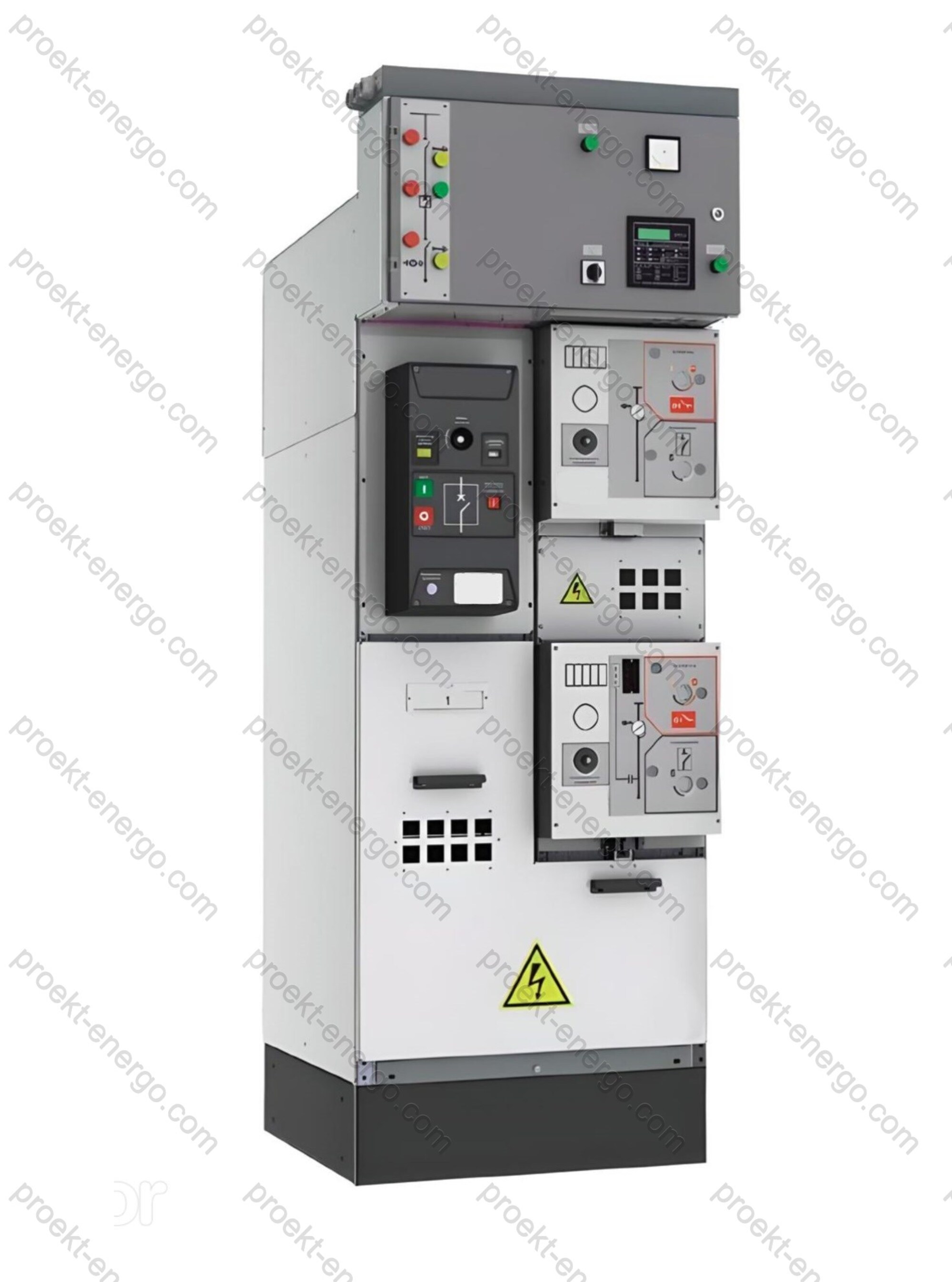
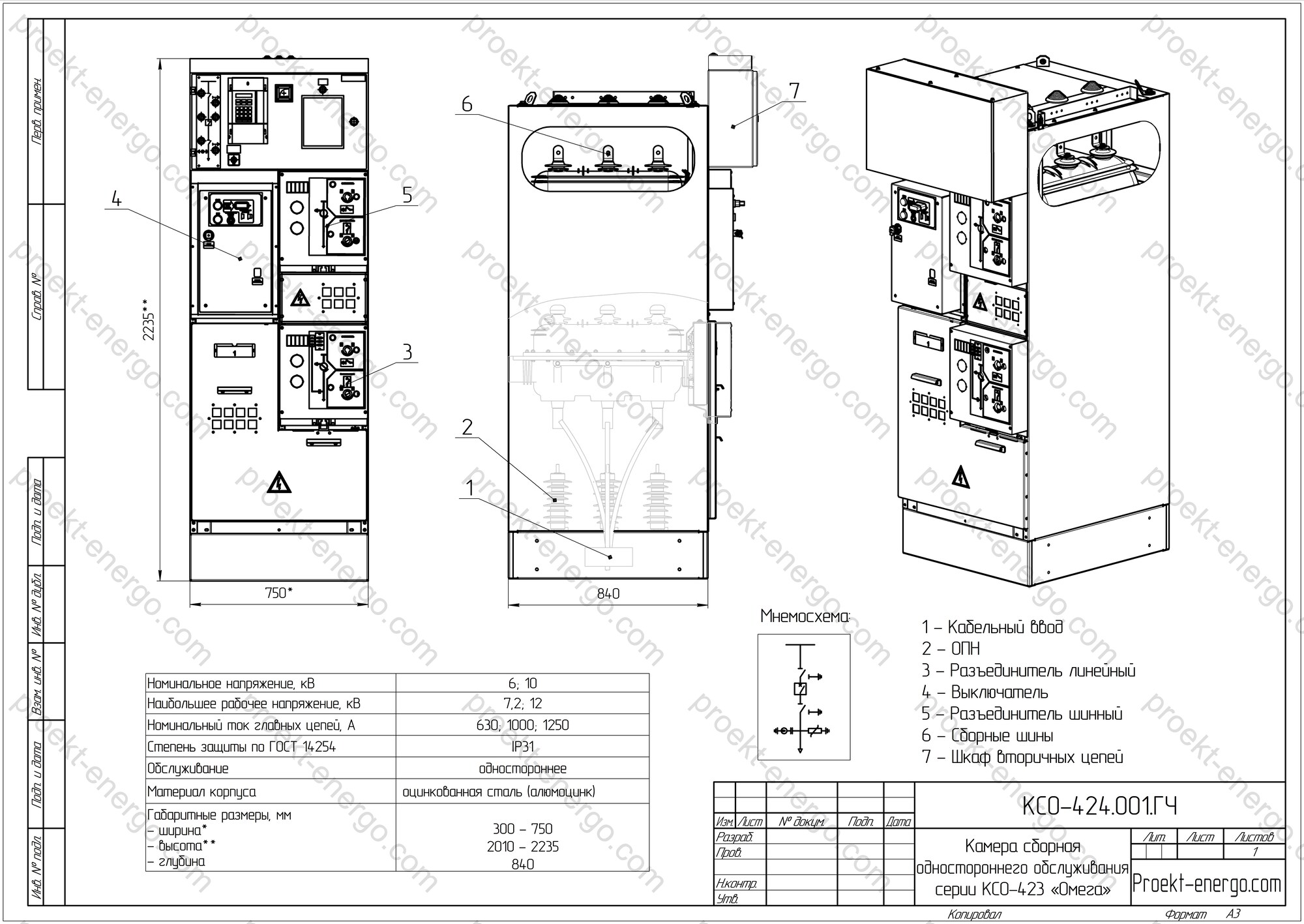
We will prepare a complete engineering package - from the tender set to shop drawings and instructions for manufacturing, assembly, and commissioning. The documentation is adapted to your project requirements, preferred apparatus vendors, and plant capabilities. If you do not plan to fabricate parts and subassemblies in-house, we can arrange cooperation at partner facilities: enclosures, draw-out trucks, busbar systems, harnesses, and mounting panels. Final assembly, electrical installation, and testing are performed at your site with our technical support.
- Pre-tender technical package: single-line diagrams, equipment lists, data sheets, standards-compliance matrices, 3D models/renders, and an explanatory note with effort, schedule, and risk assessment.
- Shop drawings and 3-D models: enclosure and assembly drawings, primary/secondary schematics, BOMs, purchased-parts lists, cable schedules; formats - DWG, DXF, STEP, Parasolid; models - for AutoCAD, SolidWorks, Inventor.
- Interlocking schemes and algorithms: inter-panel and intra-panel logic, trapped-key schemes, safe-operation sequences, signal/condition tables, integration of VDIS and arc-flash protection into the overall system.
- Commissioning and operation: insulation-test programs, secondary-circuit verification, P&C IED settings, FAT/SAT protocols, maintenance regulations with task periodicities and control charts.
Benefits of working with us
You do not need to maintain a large engineering staff: our documentation set enables a mid-level engineer to start serial production without costly prototypes. We support the project end-to-end - from short-circuit studies and apparatus selection to IEC-compliant documentation, to staff training on safe switching and interlocks, crimping procedures, and torque charts.
For additional information on KSO-423 “Omega” please contact: inbox@proekt-energo.com
PDF - Download KSO-423 technical information