RG-220 Horizontal-rotating type disconnector, rated voltage 220 kV
RG-type disconnectors are intended for making and breaking no-load sections of an AC circuit energized up to 220 kV, as well as for earthing (grounding) de-energized sections by means of integral earthing switches.
The disconnectors are available in single-pole, two-pole and three-pole versions. The pole connected to the operating mechanism is the driving pole. Operating mechanisms are intended to operate the disconnectors. Rotation of the operating shafts of the main circuit and the earthing switch is performed manually using PRG-6 mechanisms, or with a PD-14 motor drive.
Disconnectors are manufactured for outdoor installation in moderate to cold climates in accordance with EN/IEC 60721-3-4 (non-weather-protected locations; replaces references to GOST 15150), and the following service conditions apply:
- installation altitude up to 1000 m above sea level;
- upper operating ambient air temperature +40 °C;
- lower operating ambient air temperature -60 °C;
- wind speed up to 40 m/s with no icing and up to 15 m/s with glaze-ice up to 20 mm thick;
- average annual relative humidity 80% at +15 °C;
- maximum wind pressure 700 Pa (equivalent to 34 m/s) with no icing;
- maximum wind pressure 140 Pa (equivalent to 15 m/s) with ice accretion up to 20 mm.
Insulation withstand performance meets the requirements for 220 kV class disconnectors per GOST 1516.3-96. The creepage distance of the external insulation for serial products on porcelain insulators per GOST 9920-89 is:
- for pollution class I - not less than 405 cm;
- for pollution class II - not less than 505 (570) cm;
- for polymer insulators - not less than 505 (570) cm.
Mechanical endurance - 10,000 CO operating cycles.
Technical data
| Rated voltage, kV | 220 |
| Highest operating voltage, kV | 252 |
| Rated current, A | 1000; 2000; 3150 |
| Rated short-time peak withstand (electrodynamic), kA | 100; 125 |
| Rated short-time withstand current, kA | 40; 50 |
| Duration of short-time withstand current, s - for main blades - for earthing switches |
3 1 |
| Creepage distance of external insulation, cm, min. | 505 |
| Tension of conductors in the horizontal plane incl. wind effect, N, min. | 1000; 1200 |
| Minimum clearances from live parts to various elements of the disconnector, mm: - to earthed structures; - between live parts of different phases; - between open contacts within one pole |
- 1800 - 2000 - 1800 |
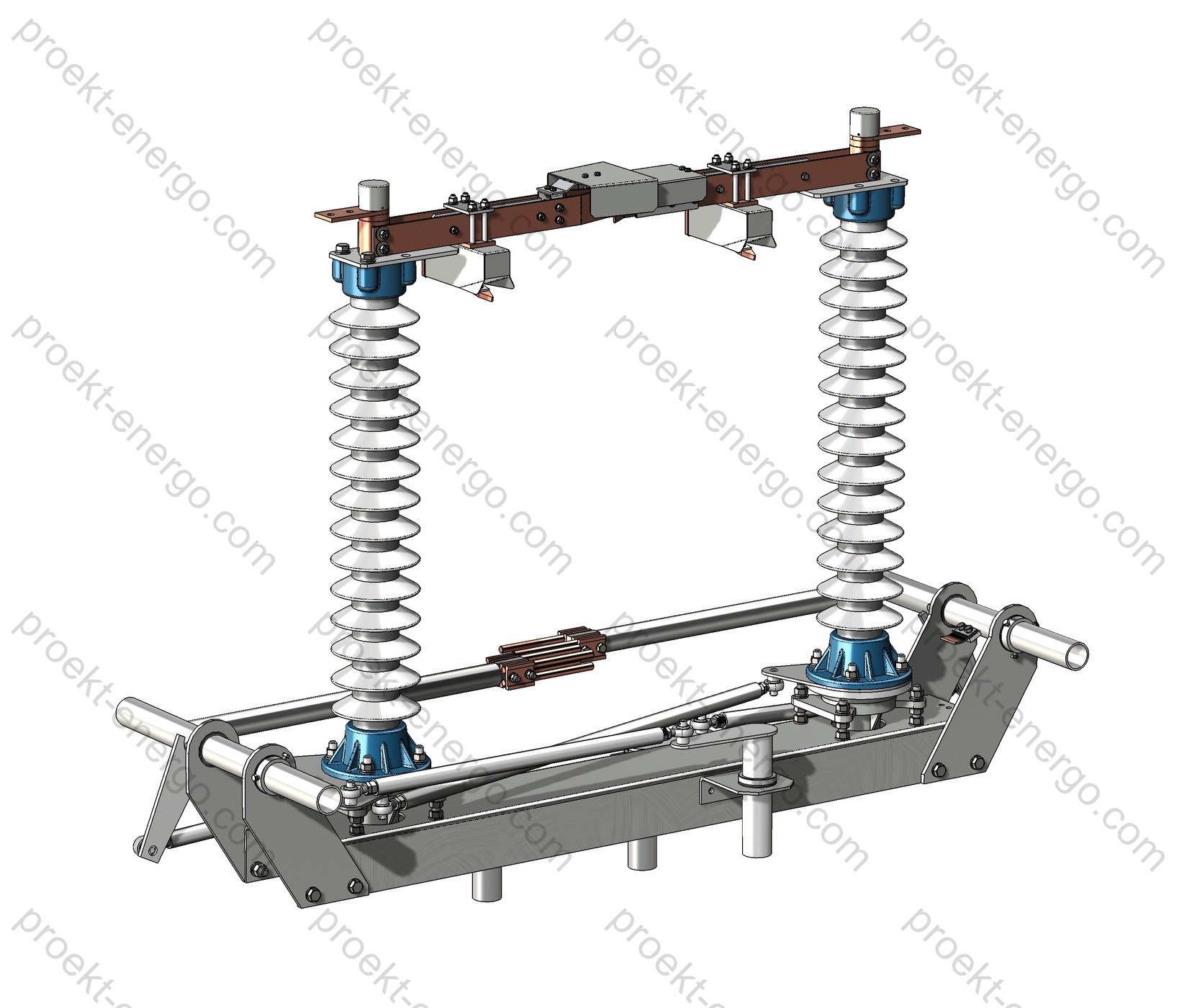
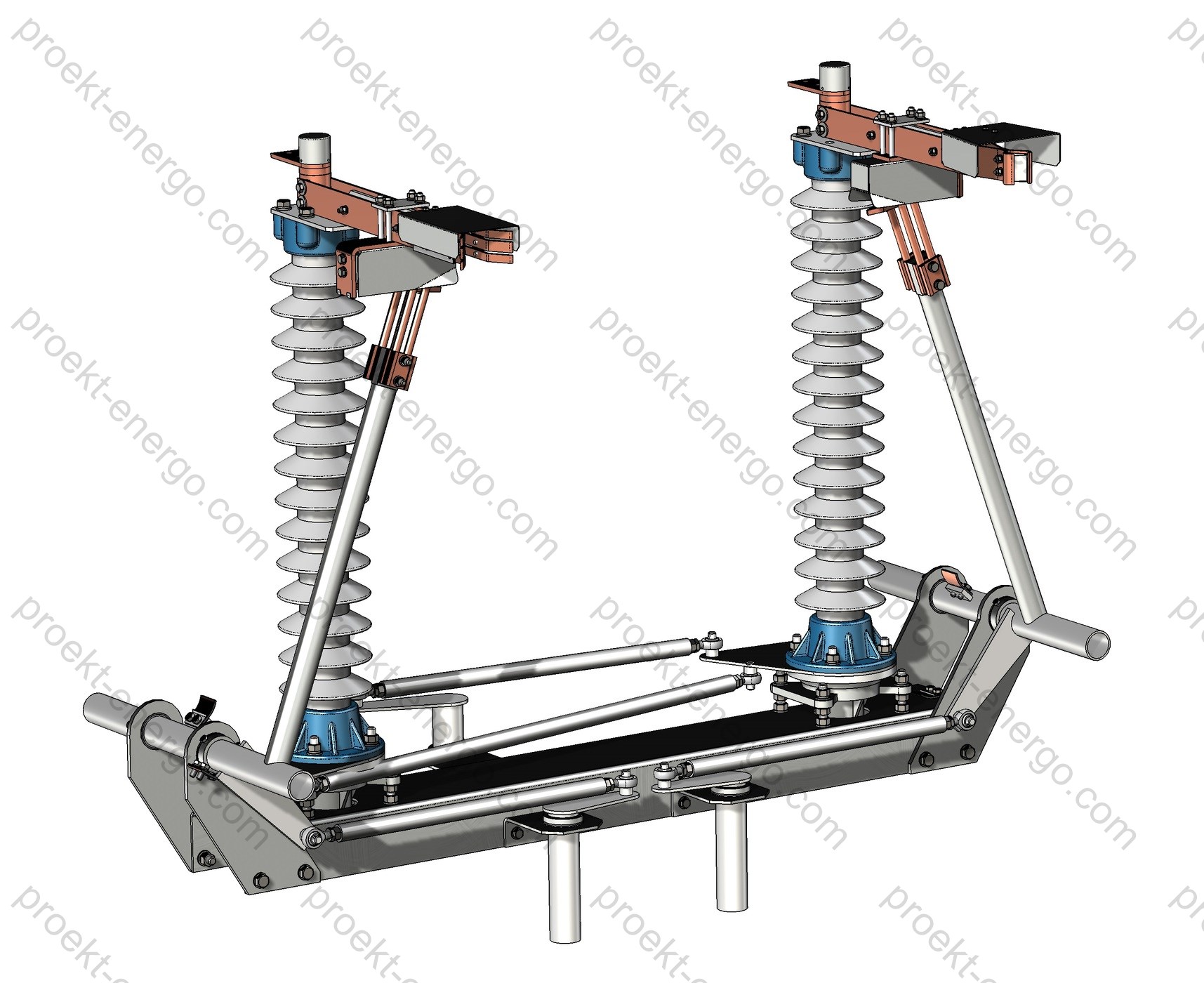
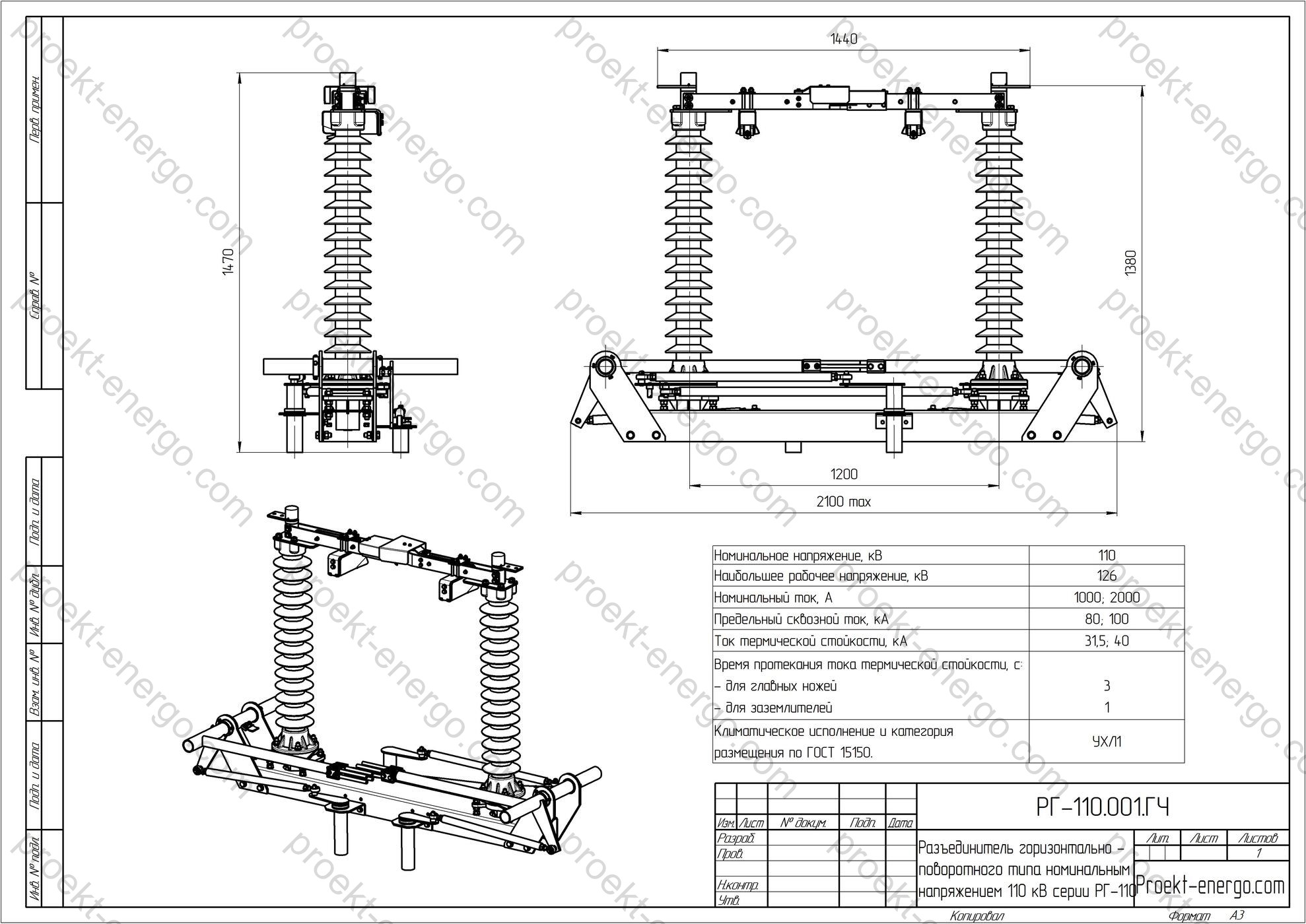
Purpose and application
RG-220 is a horizontal-rotating (center-break) disconnector for outdoor air-insulated switchgear (AIS) at 220 kV, intended for operational switching without load current, providing a visible isolating gap and safe earthing of de-energized sections during maintenance and commissioning. The design is optimized for long-term service as part of medium-voltage substation equipment with minimal maintenance needs.
Typical applications:
- 220 kV AIS of utility and industrial substations - line, bus, and sectional disconnectors, bypass and maintenance jumpers.
- Connections of 220 kV autotransformers and reactors - visible isolation on the HV side, switching of charging currents of bus and cable inserts in no-load operations.
- Making/breaking transformer magnetizing current and charging currents of overhead and cable lines provided no load current is present in the bay.
- Bus system transfer and sectionalizing, improving the operational flexibility of various substation schemes (single, double busbar, “bridge”, “one-and-a-half breaker”, etc.).
- Integration with existing units based on RDZ series - unified connection dimensions on many versions ensure compatibility in AIS upgrades without civil-works changes.
RG-220 is used in 50 Hz AC networks and intended for regions with moderate to cold climates, including areas with elevated atmospheric pollution (selection of insulation level and creepage distance - by project). The design provides high mechanical strength of the current path and supports, essential under wind, icing and short-circuit dynamic loads.
Service conditions
RG-220 complies with the environmental classes for outdoor, non-weather-protected locations per EN/IEC 60721-3-4 with an operating temperature range from -60 °C to +40 °C. Recommended site altitude - up to 1000 m a.s.l.; for high-altitude locations, insulators with increased impulse withstand and extended creepage can be supplied (per questionnaire). Wind and icing resistance are ensured by steelwork calculation and selection of insulator pollution class.
- Location category - outdoor (AIS), environmental classification per EN/IEC 60721-3-4.
- Wind load resistance up to 700 Pa without icing; with 20 mm glaze-ice - up to 140 Pa.
- Allowable ice thickness on live parts - up to 20–30 mm (with anti-icing shields and canopies - per project).
- Creepage distance of external insulation - per GOST 9920-89 for the selected site pollution class (I–IV); insulation type - porcelain/polymer.
- Resistance to solar radiation, freeze-thaw cycles, dew, rain, snow and dust - per GOST 15543.1-89.
Dielectric performance is verified by type and routine tests according to GOST 1516.3-96. For harsh pollution and salt fog, polymer insulators with increased creepage and/or protective housings over contact assemblies are recommended.
Layout and design solutions
RG-220 is a horizontal-rotating disconnector built on a modular principle. A basic pole comprises:
- Support frame with a rotating base forming the kinematic unit of the main blade. The frame is made of steel with hot-dip/thermo-diffusion galvanizing; non-ferrous parts feature tinned or silvered electroplated coatings for long-term corrosion resistance.
- Support insulators (porcelain or polymer) of the required mechanical and electrical strength. Insulator profile is selected by site pollution class; screen fittings and anti-icing housings are available.
- Main blade with laminated (finger) contacts ensuring minimal contact resistance and an endurance of at least 10,000 cycles. The design prevents misadjustment under peak currents and thermal cycling.
- Terminals (connection pads) for flexible/rigid busbars with thermal-expansion compensators; corona rings are available on request to reduce local field stress at terminals.
- Earthing switch (single- or double-side) with secure latching in the closed position against blow-off under short-circuit forces. Mechanical interlocking prevents simultaneous closing of the main blade and the earthing switch.
- Operating linkage based on rods with sealed ball-bearing supports and joints that require no lubrication for life, reducing operating torque and ensuring smooth travel.
- Operating mechanism - PRG-6 (manual) or PD-14 (motor). Options include limit switches, position sensors, electromagnetic and/or key interlocks, and local/remote control devices.
Particular attention is paid to contact durability: silvered/tinned surfaces resistant to erosion; contact areas are shielded from precipitation. Supply is in large sub-assemblies with complete fastening kits to speed installation and eliminate on-site welding. Connection dimensions are unified and, in most variants, match the replaced RDZ series, simplifying AIS modernization.
Versions and configurations
| Version | Description | Purpose/notes |
| Single-pole | Separate poles synchronized by tie-rods | Flexible layout on non-standard gantries |
| Two- and three-pole | Common frame/shared mechanism | Faster installation, unified maintenance |
| With earthing switch | Single- or double-side blade | Safe earthing of de-energized sections |
| Insulation type | Porcelain/polymer, pollution classes I–IV | Selection per site conditions and codes |
| Operating mechanism | PRG-6 (manual) / PD-14 (motor) | Local and remote control |
| Anti-icing | Shields, canopies, housings | Operation with 20–30 mm icing |
Safety and interlocks
A comprehensive interlocking system prevents hazardous mal-operations. A rigid mechanical interlock between the main blade and the earthing switch excludes simultaneous closure. Operating mechanisms can be equipped with electromagnetic interlocks, position signalling contacts, and key interlocks for inter-equipment schemes. “Dead-center” latching prevents spontaneous movement under wind, vibration or electrodynamic forces.
Visual position indication of the main and earthing blades is provided by markers and/or flags on the linkages. A safe operating area is provided at the mechanism; manual handles are folding and captive (to prevent loss and unauthorized operation). Motor drives can be supplied with heated enclosures, SPDs and terminal blocks for integration into SCADA/I&C circuits.
Options and accessories
- Main-circuit rated currents: 1000, 2000, 3150 A; short-time withstand - 40/50 kA (3 s) for main blades, 1 s for earthing switches; peak withstand - 100/125 kA.
- Terminal orientations (horizontal/angled), corona rings, transition busbars and expansion compensators.
- Polymer insulators with increased creepage for heavy pollution; porcelain for standard conditions.
- Protective canopies and screen fittings for contact assemblies to operate in severe icing and drifting snow.
- Position sensors and operation counters, limit switches, “dry contacts” for telesignalling and telecontrol.
- Key and electromechanical interlocks, including compatibility with common trapped-key systems.
- Mounting pedestals, gantries, fastening kits and inter-pole tie-rods for standardized on-site assembly without welding.
Standards compliance
RG-220 disconnectors are designed and manufactured to applicable national and international norms. Depending on configuration and project requirements, compliance (or harmonization) is provided with the following standards:
- IEC 62271-102:2018/AMD1:2022 - High-voltage switchgear and controlgear. Part 102: Disconnectors and earthing switches.
- GOST R 52726-2007 - AC disconnectors and earthing switches above 1 kV. General requirements and test methods.
- GOST 1516.3-96 - AC equipment 1–750 kV. Insulation withstand requirements.
- GOST 9920-89 - Creepage distance of outdoor insulation of electrical installations.
- EN/IEC 60721-3-4 - Classification of environmental conditions. Stationary use at non-weather-protected locations (replaces references to GOST 15150 for outdoor application).
- GOST 15543.1-89 - General requirements for resistance to climatic environmental effects.
Operational advantages
- Very low contact resistance due to optimized geometry and surface coatings.
- Maintenance-free bearing units and joints - reduced O&M costs and longer service intervals.
- Enhanced resistance to ice and wind; withstands electrodynamic forces under short-circuit conditions.
- Unified connection dimensions, compatibility with earlier series, and straightforward retrofit without civil changes.
Documents
- Complete set of working drawings (assemblies, parts and standard items); BOMs and lists of purchased components.
- 3D models of units and poles for design integration: AutoCAD (DWG/DXF), SolidWorks, Parasolid (x_t), STEP; models for strength calculations on request.
- Routing cards and process sheets (on request), installation and adjustment manuals, typical quality control plans, list of spares.
- Questionnaires for RG-220 and operating mechanisms, plus specification templates for inclusion in project “Electrical part”.
Engagement with contractors, manufacturers and investors
We are open to cooperation with machine-building companies and investors interested in establishing production of RG-220 disconnectors. We provide technology support, guidance on selecting suppliers of insulators, fittings and operating mechanisms, as well as assistance in organizing the supply chain and quality control. For contractors, we adapt drawings to the existing equipment fleet, recommend protective coatings (galvanizing, silvering/tinning), and select standard units and fasteners subject to market availability. Licensing agreements for serial production are possible, including know-how transfer and commissioning support for the first batch.
Why work with us
- No need to maintain a large in-house engineering team - you receive a complete documentation set that can be handled by a mid-level engineer.
- No need to build prototypes - our experience enables successful launch of serial production straight away.
- Working to our documentation, your staff will receive consulting on all nuances of manufacturing RG-220 disconnectors.
For additional information on RG-220 disconnectors please contact: inbox@proekt-energo.com
PDF - Download technical information on RG-220 disconnectors