KM-1 Switchgear - replacement of the withdrawable unit (retrofit)
Retrofit is the modernization or partial re-equipping of MV switchgear (KRU) and KSO by replacing physically and functionally obsolete devices with modern ones, without a full reconstruction of the switchgear room.
First of all, modernization focuses on replacing the most worn and critical component - the oil circuit-breaker. Preferred are vacuum or SF6 circuit-breakers with spring-charged or electromagnetic mechanisms that are maintenance-free, offer a high number of operating cycles, and tolerate frequent operations. A comprehensive KRU upgrade is also possible: block replacement of the compartment (withdrawable unit, shutters, earthing switch, doors, relay cabinet), as well as upgraded terminals and cable entries.
The reliability of KRU or KSO directly depends on the switching equipment. Such modernization is a simple and cost-effective way to improve availability and operational safety.
Retrofit is more economical than complete replacement, reduces the scope of design and installation works, and cuts downtime; periodic maintenance of old breakers does not guarantee reliability, while other cubicle components may not require replacement.
Typical replacement options:
Replacement of the breaker using an adaptation kit, with updated interlocks and secondary connectors; requires verification of opening time and contact pressure. The most economical, but longer and more labor-intensive option.
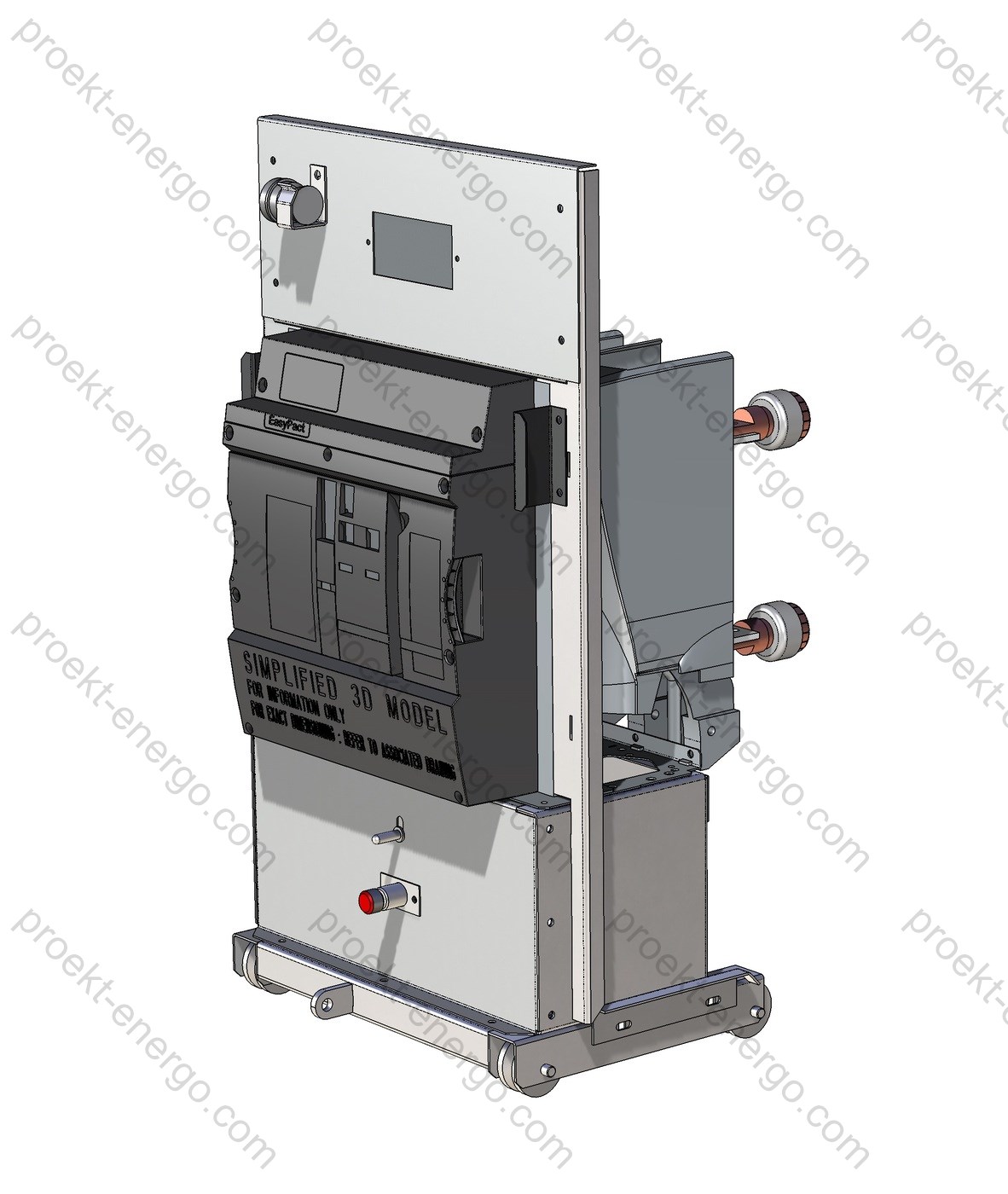
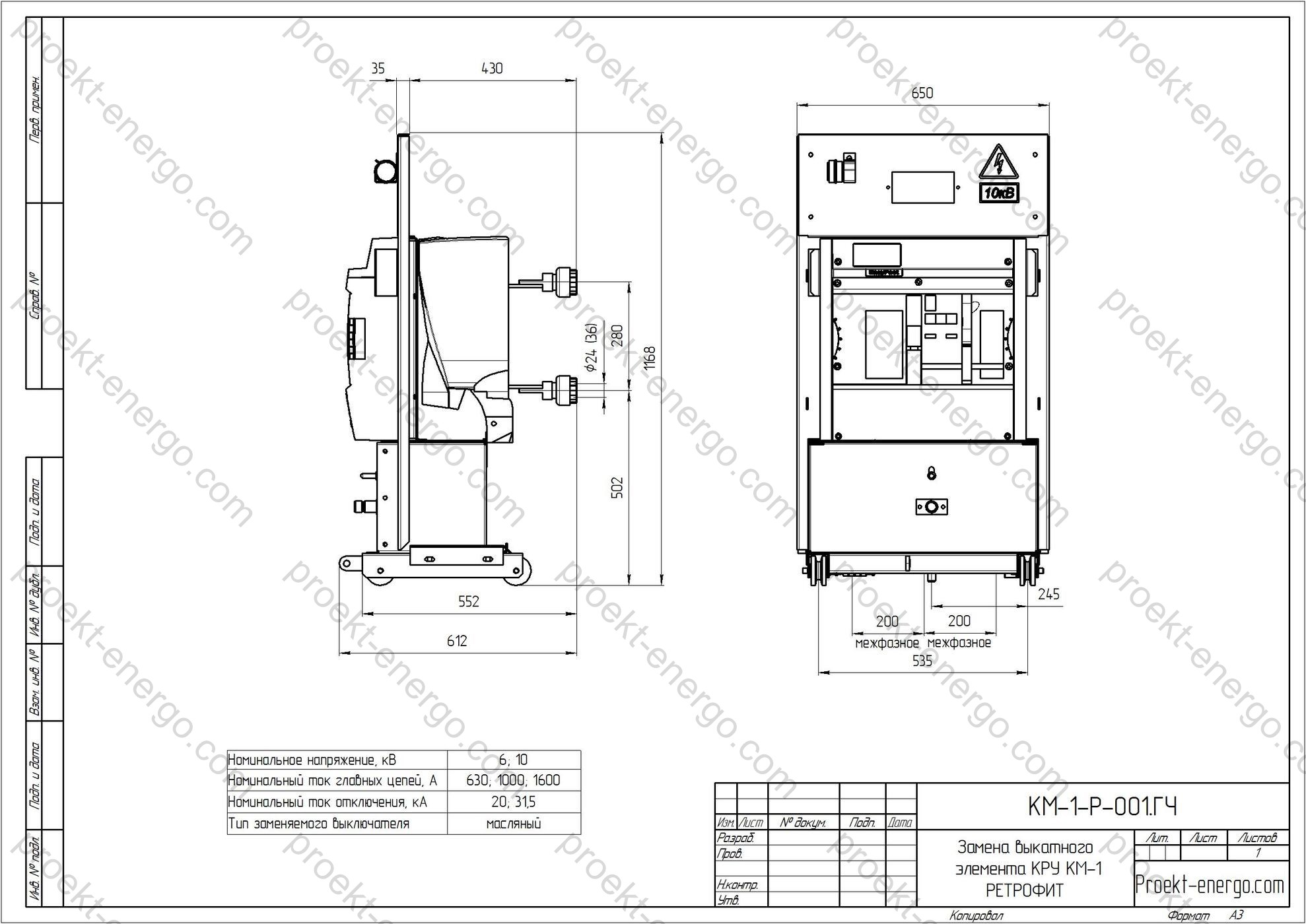
Replacement of the entire withdrawable unit with a new one, fully compatible in dimensions and interlocks. Fast and almost without modifications; the old truck with the oil/minimum-oil breaker can be kept as a spare.
“OneFit” - a factory module with breaker, mechanical/electrical interlocks, shutters, and an adapted contact system. Advantages:
- improved dielectric clearances and temperature control;
- type tests per IEC 62271-1/-100 (including mechanical endurance);
- high reliability of mechanisms and fewer assembly errors.
Technical data
| Parameter | Value | Comment |
|---|---|---|
| Rated voltage | 6; 10 (up to 12) kV | Depends on breaker series |
| Rated frequency | 50 Hz | 60 Hz on request |
| Rated continuous current | 630…3150 A | Frame size selected by load/busbars |
| Rated short-circuit breaking current | 16; 20; 25; 31.5 kA | 3 s, peak up to 40–80 kA |
| Endurance class | E2/M2 (C2 - option) | Per IEC 62271-100 |
| Operating cycle | O-0.3 s-CO-3 min-CO | Standard sequence |
| Operating mechanism | Spring-charged, motor-operated | Manual charging - backup |
| Degree of enclosure protection | IP31…IP41 (per design) | Per IEC 60529 |
| Service conditions | -5…+40 °C, RH≤95 % | No condensation; altitude ≤1000 m |
| Secondary control circuits | 110/220 V DC; 220/380 V AC | Vibration-resistant terminals |
| Withdrawable unit mass | from 180 to 420 kg | Depends on configuration |
| P&C interfaces | IEC 61850, Modbus, Profibus | By customer choice |
| Safety options | IAC design, arc-flash sensors | Per project specification |
Purpose and application
The upgrade kit for the withdrawable unit of KM-1 switchgear is intended to extend the lifetime of existing medium-voltage 6–10 kV switchgear at industrial facilities, urban and rural substations, mining, oil & gas, and infrastructure sites. The main task is to replace the oil/minimum-oil breaker with a modern vacuum or SF6 circuit-breaker, integrating it into the existing mechanical and electrical architecture of the cubicle without altering the cabinet, bus bridges, cable entries, or foundation.
Retrofit is relevant when:
- failures increase due to wear of arcing contacts and seals;
- CAPEX is limited and full switchgear replacement is impractical;
- it is necessary to improve operational readiness and reduce restoration time after short-circuits;
- migrating to modern digital protection and automatic transfer schemes;
- occupational/industrial safety requires minimizing arc-flash risk and erroneous operations.
Applications include OHL/Cable line feeders, sectionalizing and line breakers, motor starters, transformer feeders, and incoming/backup lines. During the reconstruction period, a parallel approach is possible - the new withdrawable truck is installed in each cubicle in turn, reducing forced downtime.
Service conditions
KM-1 retrofit solutions are engineered for standard indoor service conditions per IEC 62271-1 for metal-enclosed switchgear:
- ambient temperature: -5 °C to +40 °C (short-term up to +45 °C);
- relative humidity up to 95 % without condensation (anti-condensation heating in the secondary and power compartments);
- installation altitude up to 1000 m ASL without derating; above this - current derating per project annex tables;
- normal/elevated pollution categories (for elevated pollution: additional sealing, moisture protection, anti-corrosion coatings);
- seismic performance per specification (travel limiters, truck latches, reinforced guides);
- enclosure protection degree: at least IP31 (external surfaces), within compartments - per cubicle design; for dusty/humid rooms IP41/54 at doors and vent filters can be provided.
Operation is permitted in systems with solidly earthed (TN) and isolated (IT) neutrals; corresponding earth-fault protections and insulation monitoring options are selected. For cold climates, heaters, thermostats, and conformal coatings for P&C boards are applied. In chemically aggressive atmospheres, additional coatings of metalwork and sealing of secondary terminals are provided.
Transport and storage - as per instructions: -25 °C to +55 °C, no condensation, stacking no more than two layers, with vibration protection.
Layout and design solutions
The modernized KM-1 withdrawable unit reproduces the mounting bases and kinematics of the standard truck, ensuring full compatibility with rails, stops, operating rods, and the shutter mechanism. Main assemblies:
- Switching device - vacuum circuit-breaker (SF6 optional). Mechanical/electrical endurance class E2/M2, lifetime at least 10–30 thousand operations depending on series. Versions available for 6 and 10 (12) kV with breaking capacity 16–31.5 kA.
- Operating mechanism - spring-charged motor-operated (standard) or electromagnetic; manual spring charging and remote control. Mechanical indicators “ON/OFF/CHARGED” provided.
- Contact system - fixed “tulip” contacts and truck stabs with silver plating, adjustable contact force, and calibration pins. Geometry coordinated with KM-1 truck insertion depth.
- Shutters and barriers - automatic shutters of the busbar and cable compartments preventing access to live parts in the withdrawn position. Non-flammable materials with arc-resistant inserts at pass-through points.
- Interlocks - mechanical (motion recovery, earthing switch drive can be disengaged only with the truck withdrawn), electrical (position limit switches, shutter sensors), electromagnetic door locks when the breaker is ON. Inter-door key logic “key-key” for sections is available.
- Secondary circuits - multipin connectors (Harting-type/analog) with keying, harnesses in PVC/FRLS conduit, ESKD-style marking. Standard levels 110/220 V DC, 220/380 V AC supported. Entries on vibration-resistant terminals.
- Protection & Control - installation of digital IEDs (e.g., line/transformer/motor protection, autoreclosing/automatic transfer, event logs, oscillography). Optical arc sensors in compartments for ultra-fast tripping.
- Chassis and guides - reinforced rollers, limiters, position latch “service/test/connected”. Handle/wrench for smooth insertion; optional screw-in mechanism.
- Earthing switch - built-in/fixed earthing (grounding) switch in each cubicle with independent drive; interlocks prevent its closing in the “connected” position.
For projects requiring a high degree of uniformity, a modular “cradle-in-cradle” retrofit is used: a new cradle frame with device, adapted connectors, and shutters is installed into the existing compartment. This approach reduces on-site assembly labor, ensures parameter repeatability, and simplifies maintenance.
Comparison of supply/modernization options
| Option | Scope | Installation | Advantages | Notes |
|---|---|---|---|---|
| Breaker adaptation kit | New CB + brackets, linkages, interlock retuning, contact modifications | Medium effort; requires contact centering and shutter adjustment | Minimal CAPEX, truck retained | Requires precise alignment; extended commissioning |
| New withdrawable unit (assembled) | Truck + CB + shutter assembly + connectors; factory testing | Fast commissioning; minimal in-cubicle work | Reduced downtime, uniformity across the section | Higher cost than adaptation kit |
| “Cradle-in-cradle” module (OneFit-type) | New cradle frame, standard interfaces, door/lock upgrades | Short installation time, plug-and-play | Type-tested, improved clearances | Compartment geometry survey required |
Safety
The primary priority of the retrofit is personnel safety. The solution provides multiple layers: door electromagnets and limit switches, interlocks with the earthing switch drive, inter-section key systems, voltage presence indicators, and locks on drives. On request, a design with enhanced internal arc resistance (IAC) can be implemented using pressure relief ducts, panel fixation, and reinforced doors. Installing arc-flash sensors (optical/current) is recommended, enabling ultra-fast clearing (about 10–15 ms for detection + breaker time). Interlocking schemes prevent racking-in/out with the breaker ON, closing the earthing switch in the “connected” position, and accessing the power compartment with open shutters.
To improve operational safety, the following are implemented:
- P&C self-diagnostics, readiness check of mechanisms, breaker lifetime signaling;
- error-proofing: color-coded controls, pictograms, “two-hand” logic;
- temperature monitoring of bolted joints (built-in sensors/thermal tags);
- anti-condensation system (heaters + hygrostat);
- maintenance plan with inspection and lubrication schedule by operating hours and number of operations.
Manufacturing options and extras
- Ratings: Ur 6; 10 (up to 12) kV; Ir 630, 1000, 1250, 1600, 2000, 2500, 3150 A; breaking capacity 16; 20; 25; 31.5 kA (3 s, peak up to 40–80 kA depending on breaker series).
- Mechanisms: spring-charged motor-operated (standard), electromagnetic (per spec), with manual charging; endurance up to 30 thousand operations.
- Protection: IEDs for lines/transformers/motors, power quality measurement, automatic transfer/autoreclosing, logs & oscillography, IEC 61850/Modbus/Profibus interfaces.
- Instrument transformers: CTs class 5P/10P/TP (for fast tripping), VTs single-/three-phase, option for built-in sensors on the frame.
- Climatic design: anti-corrosion coating, heaters, sealing; conformal coating of P&C boards; cold-climate execution.
- Metering & monitoring: telemetry via Ethernet/RS-485, SCADA integration; parameter dashboards, asset lifetime reports.
- Visual indication: mechanical flags, LED panels “Voltage Present”, “CB ON/OFF”, “Earthed”, “Truck Position”.
Standards compliance
Design and supply are performed in line with applicable international and regional standards. Depending on the scope, the following (up to six key) standards apply:
- IEC 62271-200 - AC metal-enclosed switchgear and controlgear above 1 kV and up to 52 kV: enclosure requirements, LSC categories, partitions, internal arc (IAC).
- IEC 62271-100 - Medium-voltage AC circuit-breakers: E2/M2/C2 classes, breaking capacities, endurance.
- IEC 62271-1 - Common specifications, service conditions, tests.
- IEC 62271-102 - Disconnectors and earthing switches: drive requirements, visible isolation, interlocks.
- IEC 60529 - Degrees of protection (IP Code), applicable to doors/panels.
- IEC 62271-304 - Guidance for severe environmental conditions (low temperatures, icing, pollution) - when specified.
Note: compliance of specific KM-1 cubicles with IAC, LSC categories, partition classes, and IP degrees is confirmed by type and/or routine tests as part of the modernized cabinet per the project test program.
Engagement with contractors, manufacturers, and investors
We are open to cooperation with mechanical engineering plants (metalwork, machining, powder coating), electrical manufacturers (harnesses, CTs/VTs, terminal assemblies), installation companies, and investors. Engagement is flexible: from supply of a complete “truck-assembled” kit to transfer of design documentation and site supervision, including staff training, P&C commissioning, and start-up support on site. For series production - we ensure unit standardization, man-hours, BOMs, process sheets, an applicability matrix for KM-1 cubicle types, and marketing support (catalogs, photo/video materials, bench tests).
Deliverables (drawings and models)
The project includes a package of design documents and 3D models: BOMs, assembly and detail drawings, secondary wiring schematics, cable schedules, parts lists, installation and O&M instructions. Formats: DWG/DXF (AutoCAD), SLDPRT/SLDASM (SolidWorks), STEP/Parasolid (exchange), PDF (plots), CSV (connection lists). On request - neutral IGES, purchased-parts lists, electrical installation cards, P&C settings tables, and test-protocol templates.
Bottom line: a KM-1 retrofit with withdrawable-unit replacement means minimal civil changes, rapid implementation, higher reliability and safety, readiness for digital P&C and monitoring systems, as well as predictable project schedule and cost.
Why work with us
- No need to maintain highly qualified engineering staff - you receive a documentation set for the product to be manufactured, which can be handled by a mid-level engineer.
- No need to build pilot prototypes - our experience allows you to start serial production successfully.
- Working to our documentation - your specialists will receive guidance on all nuances of replacing the withdrawable unit of KM-1 switchgear.
For additional information on replacing the withdrawable unit of KM-1 switchgear (retrofit), please contact: inbox@proekt-energo.com
PDF - Download technical information on replacement of the withdrawable unit for KM-1 switchgear
Documents