Single-front medium-voltage switchgear 10 kV, type KSO-366
KSO-366 is a family of single-front medium-voltage (6–10 kV) switchgear panels designed for the reception, distribution, and dependable switching of three-phase 50 Hz AC. The panels operate in systems with isolated or earthed neutral and are installed indoors in metal-enclosed switchrooms of unit substations, at industrial sites, in auxiliary switchgear of power plants, and on municipal and transport infrastructure facilities. The design is optimized for fast installation: panels are equally at home in permanent switchrooms and factory-built modular buildings, which simplifies refurbishment of existing substations and accelerates commissioning of new assets.
Purpose and application
KSO-366 forms incoming, bus-section, and feeder connections in 6–10 kV switchgear lineups. The series covers intake from power transformers, connection of cable/overhead lines, busbar sectionalizing with automatic transfer schemes, auxiliary services, and metering/measurement functions. Unified connection dimensions and available adapter panels allow new panels to be tied into existing busbars and cable routes with minimal outages. For new builds, standard one-line and functional schemes shorten engineering time and ease approvals.
Service conditions
The base design is for indoor installation in temperate climates (indoor locations). The construction tolerates the specified ranges of temperature and humidity and permits storage/transport without damage to coatings and insulation. Enclosure degree of protection - IP20, preventing accidental access to live parts and ingress of large solid objects. On request, individual compartments can be supplied with locally increased IP, subject to verification of thermal conditions and ventilation. For high-altitude sites, clearances and test regimes are adjusted; in corrosive atmospheres, enhanced coatings and Aluzinc/galvanized steel components are applied.
Layout and design solutions
Panel structures are manufactured in two concepts:
- Welded frame of structural steel with durable powder-polymer coating - for maximum mechanical rigidity and long life under heavy duty;
- Bolted sheet-metal enclosure made of steel with Aluzinc (or zinc) coating on non-welded fasteners - for rapid assembly, serviceability, and clean joint geometry.
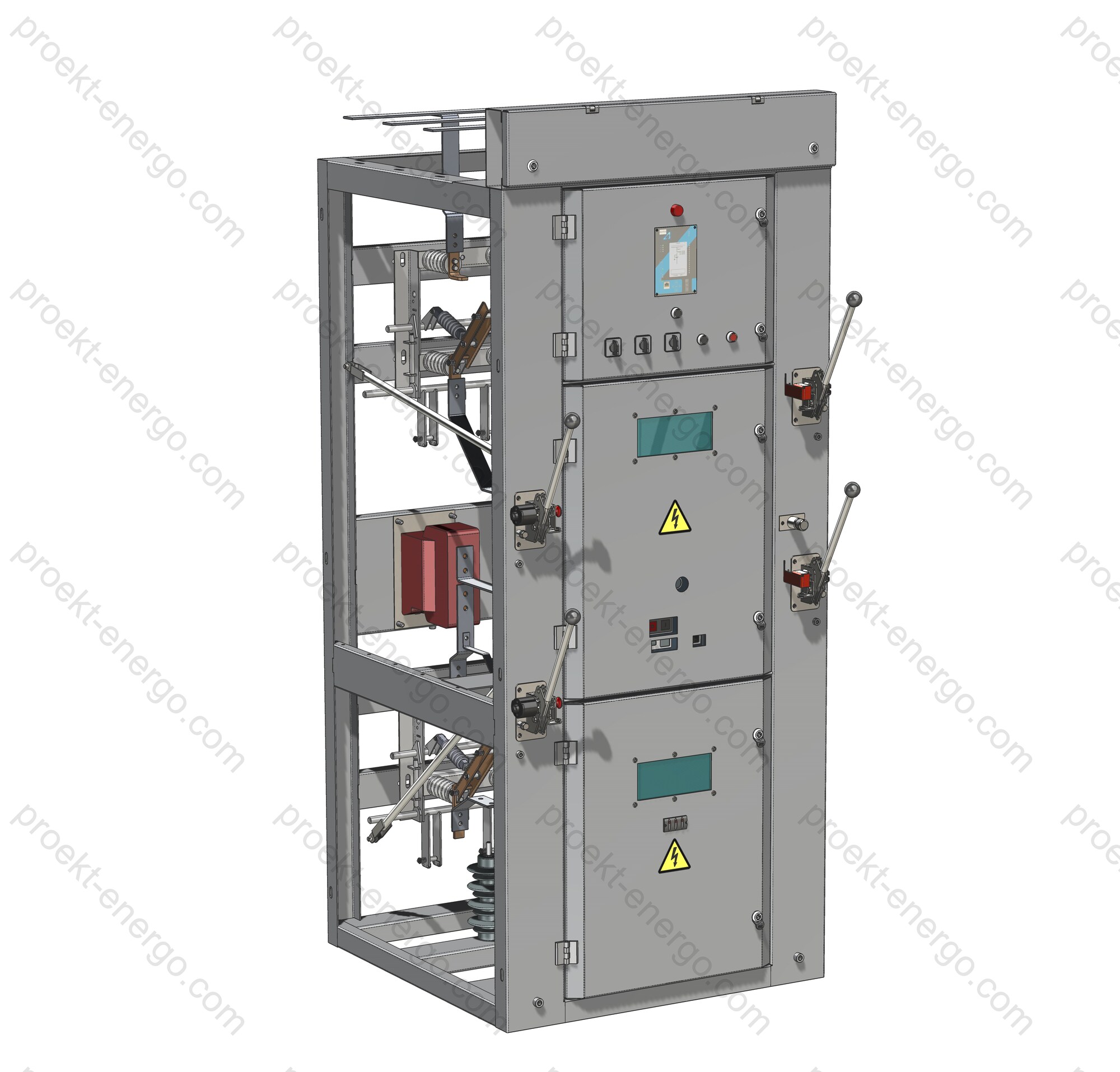
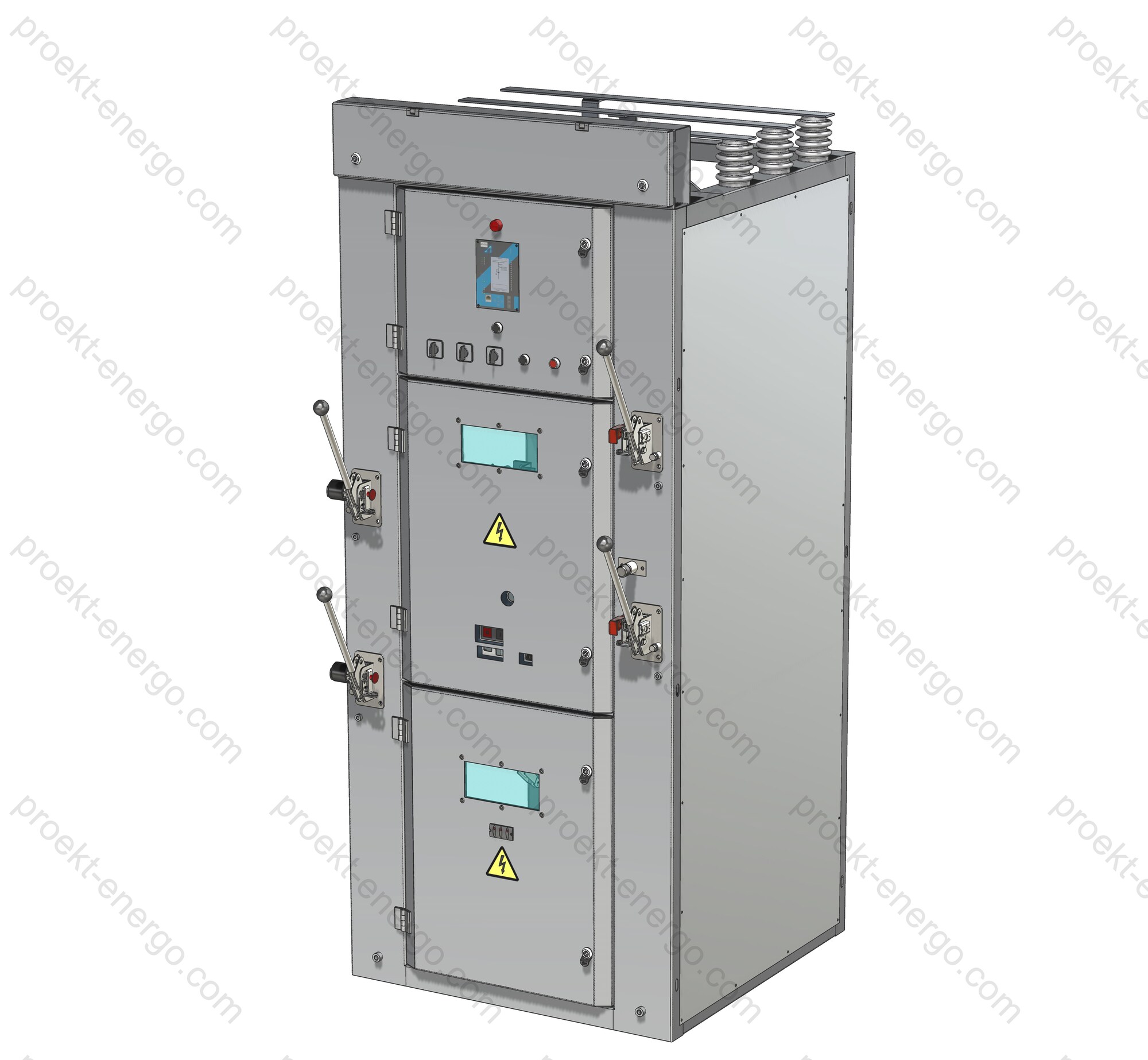
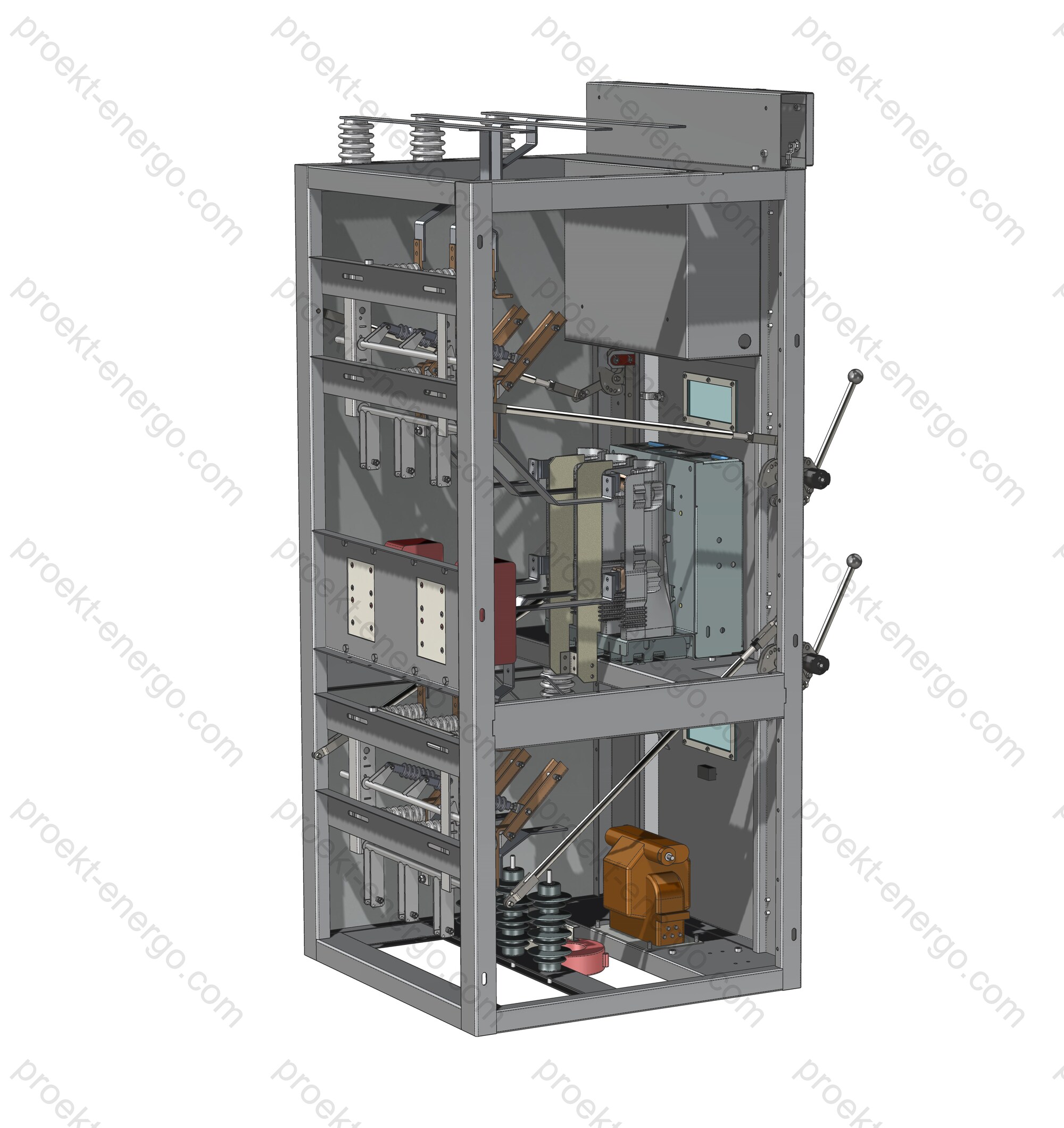
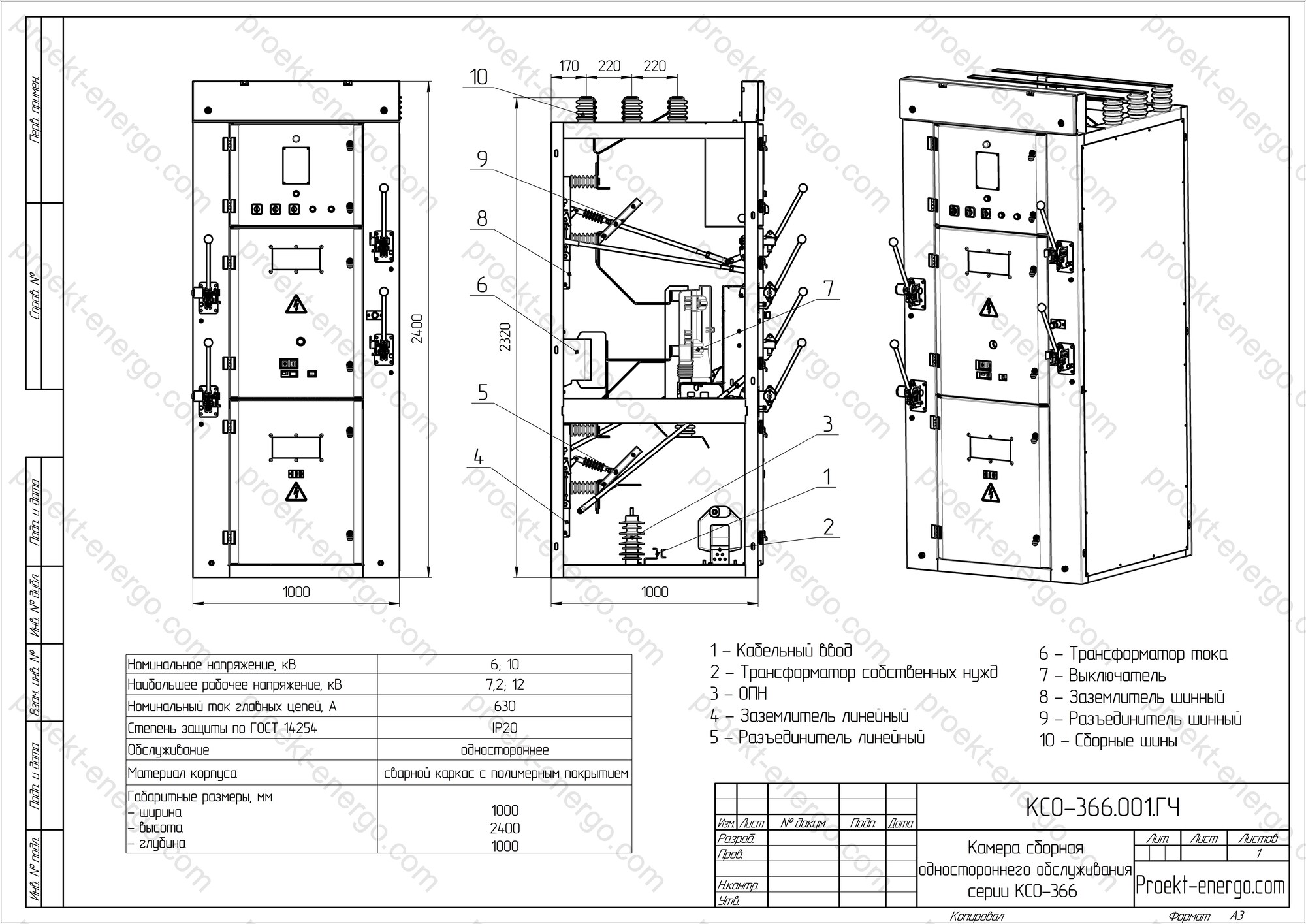
Each panel is divided into functional compartments: busbar compartment (main busbars and inter-panel links), apparatus compartment (main switching device, disconnector and earthing switch), cable compartment (entries, terminations, current transformers, supports and cable cones), and the low-voltage compartment (protection/automation IEDs, terminal blocks, measuring instruments). Viewing windows on the front enable visual status checks. Built-in task lighting and a socket for a portable lamp allow safe routine operations while keeping main and auxiliary circuits energized, provided accepted procedures are followed.
The arrangement of live parts and barriers is chosen to reduce the probability of flashovers during transients and to direct any arc-fault products into safe zones. High-current joints (busbar contacts, cable lugs) are designed for low losses and stable thermal behavior. The design documentation provides access to components subject to routine maintenance.
Safety and interlocking
Interlocking prevents hazardous actions by personnel. It is prohibited to: operate the disconnector with the circuit-breaker closed; close the earthing switch with the disconnector closed; close the disconnector onto an earthed feeder; open doors when the feeder is not earthed. Breaker operation is performed with the door closed - this is a basic safety principle. Interlocks are implemented by mechanical means and electrical position monitoring and can be supplemented with arc-flash sensors and high-speed trip functions. This architecture reduces the likelihood of injury and limits the consequences of internal faults.
Configurations and options
The series supports a wide range of configurations: incoming, bus-section (with circuit-breaker or disconnector), feeder, VT/CT panels, metering and auxiliary services, as well as bus couplers. Options include:
- selection of circuit-breaker type and operating mechanisms (manual/motor), fixed or withdrawable arrangements;
- microprocessor protection and automation IEDs (overcurrent, directional, differential, distance functions, reclosing/automatic transfer, event recording);
- measuring current/voltage transformers with accuracy classes for protection and revenue metering;
- enhanced internal arc resistance with directed energy relief and protective screens;
- extended anti-corrosion coatings, thermal insulation and heaters, busbar and cable-lug temperature sensors, partial-discharge monitoring;
- standardized busbar links, recommended spare-parts kits, and transition panels for interfacing with earlier series.
Typical 6–10 kV lineup configurations
Incoming - intake from OHL/Cable or from a power transformer, measurement and metering, optional ATS;
Bus-section - splitting busbars into sections to improve maintainability and fault-ride-through (variants with circuit-breaker or disconnector);
Feeder - outgoing cable/overhead feeders with a full protection suite and diagnostics;
VT/CT panel - supply of measuring circuits, technical/commercial metering, condition monitoring;
Auxiliary services - supply of control power and switchroom life-support systems;
Bus coupler - busbar links and bypass arrangements between sections/ducts.
Compliance and normative references
- Metal-enclosed medium-voltage switchgear: design rules, type and routine tests, internal-arc classification (IEC 62271-200).
- General requirements for medium-voltage switchgear and controlgear: service conditions, insulation levels, electrical and mechanical tests (IEC 62271-1).
- AC switching devices: performance, making/breaking capability, and test duties (e.g., circuit-breakers - IEC 62271-100).
- Disconnectors and earthing switches: requirements for drives, interlocking, and endurance (IEC 62271-102).
- Degrees of protection by enclosures (IP code): selection of IP20 and locally increased IP by zone (IEC 60529).
- Environmental conditions - classification for stationary use in weather-protected locations (EN/IEC 60721-3-3).
- Dielectric withstand: power-frequency and impulse tests confirming clearances and creepage (per IEC 62271-1/-200).
- Instrument transformers: accuracy classes and loading for protection and metering (IEC 61869-2/-3).
Operation and maintenance
The “operate with the door closed” principle reduces risk during switching and improves predictability of switchgear behavior. Recommended practices include periodic inspection of bolted joints and terminals, thermal monitoring of high-current points, verification of interlock functionality, and updating of protection settings to suit network conditions. Modularity and unified components reduce downtime during repairs and simplify spare-parts logistics.
Technical data
| Rated voltage, kV | 6; 10 |
| Maximum system voltage, kV | 7.2; 12 |
| Rated current of main circuits, A | 400; 630 |
| Rated busbar current, A | 630 |
| Thermal withstand current for 3 s, kA | 20 |
| Dynamic withstand current for 1 s, kA | 51 |
| Environmental classification and installation category per EN/IEC 60721-3-3 | Indoor |
| Degree of protection per IEC 60529 | IP20 |
| Overall dimensions, mm - width - depth - height |
1000 1000 2400 |
Documents
- Preliminary package for tenders: data sheets, one-line and functional diagrams, specifications and equipment lists - for rapid compliance checks and preparation of commercial offers.
- Full set of design documentation and 3D models to launch production at your site. If your busbar/enclosure capacity is limited, we can arrange fabrication at partner facilities; assembly, routine tests and installation are performed at your works.
- Manufacturing adaptation: prompt updates to drawings for your processes, component sourcing support, supervision of assembly and commissioning, and preparation of insulation and functional test programs.
Why work with us
- Reduced workload on in-house engineers: documentation is structured so that a mid-level engineer can work with confidence.
- Fast ramp-up to series: proven modules and repeatable solutions eliminate lengthy pilot iterations.
- Expert support: assistance with component selection, protection IED configuration, preparation of O&M documents, and staff training.
For additional information on KSO-366 please contact: inbox@proekt-energo.com
Practice shows that errors made at the design stage multiply fabrication and lifecycle costs. Careful specification of switching devices, correct selection of instrument transformers, and a well-thought-out busbar system are the basis for safe, reliable substation operation throughout its life.
PDF - Download KSO-366 technical information