Working design documentation for the manufacture of electrical equipment for substations. 3D models. Drawings. Regulatory documentation.

Outdoor switchgear blocks of complete transformer substations CTSB for voltage up to 220 kV

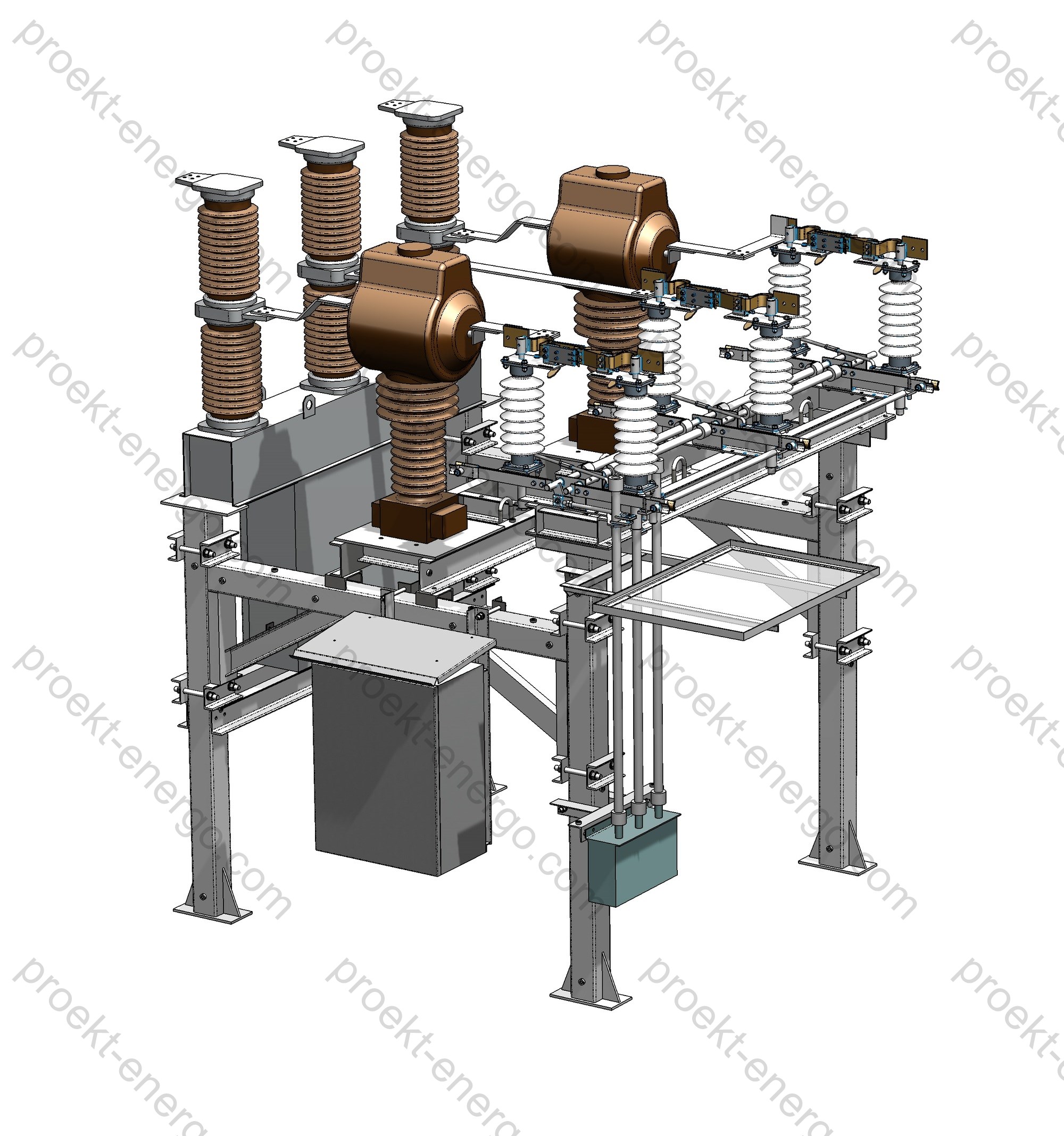
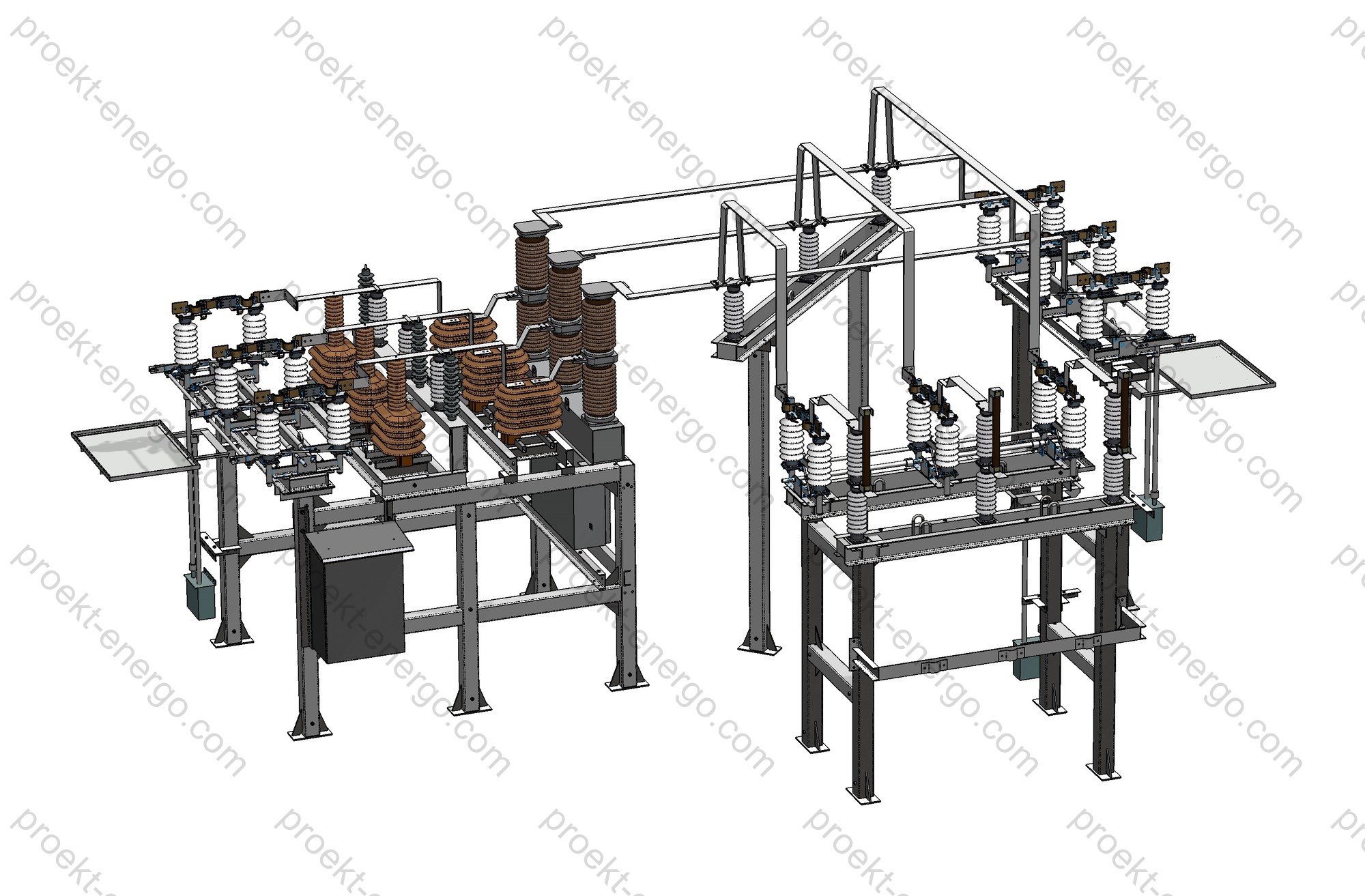
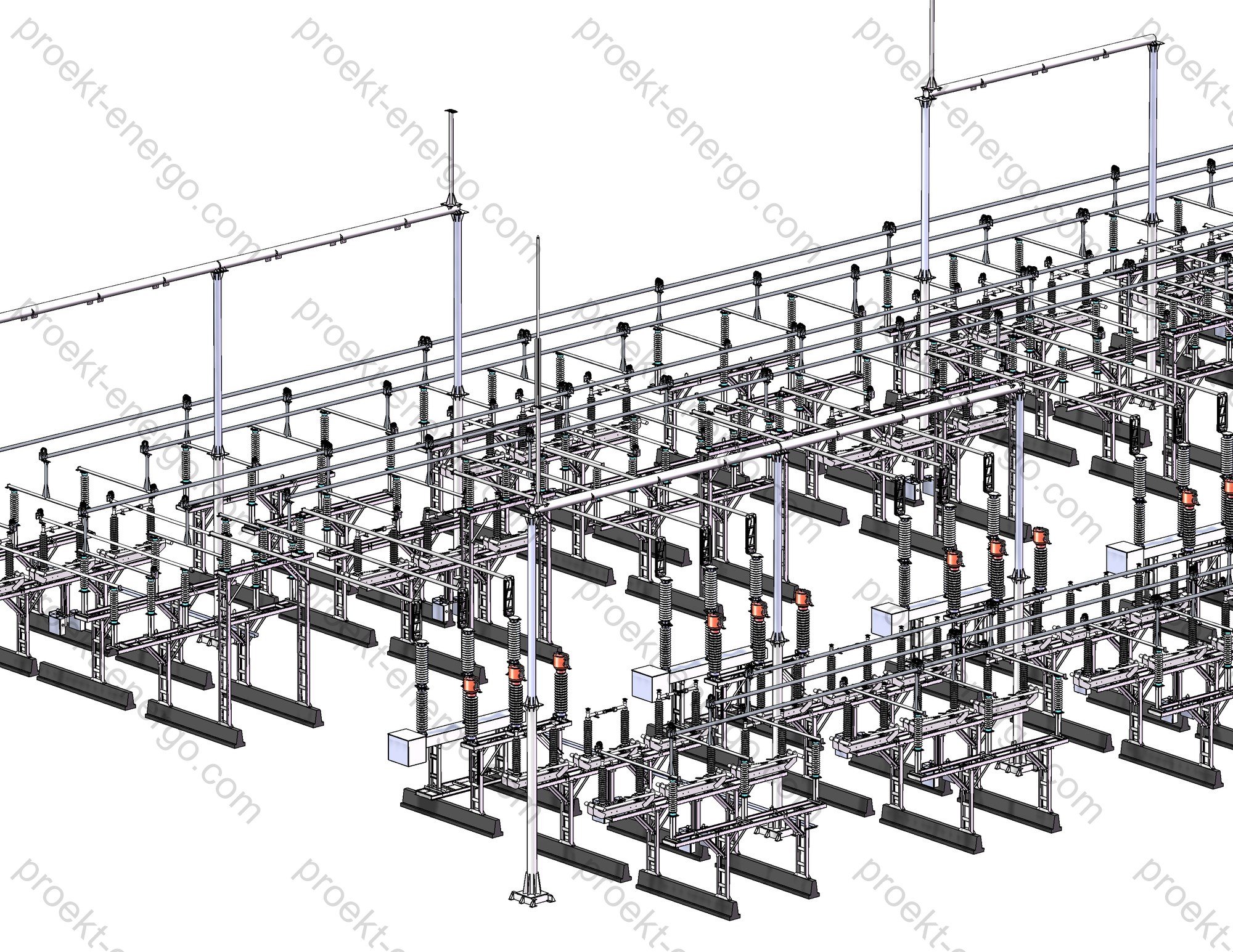
Outdoor air-insulated switchgear (AIS) blocks for prefabricated transformer substations (KTPB) rated 10(6), 35, 110, 150, 220 kV

The prefabricated modular transformer substation (KTPB) is intended for the reception, conversion, distribution, and transit of three-phase 50 Hz AC power at voltage levels of 10(6), 35, 110, 150, and 220 kV. The KTPB supplies industrial, municipal, and agricultural loads, infrastructure facilities, and is applied on the 35–220 kV side of network substations and, when appropriate, at power plants. The medium-voltage section of the KTPB is based on an outdoor air-insulated switchgear (AIS) assembled from standardized factory-built connection blocks, providing a high degree of factory readiness, shorter construction/erection time, and predictable quality of the finished facility.

AIS blocks for 10(6), 35, 110, 150, and 220 kV are designed for reception and distribution of electric power per the required schemes, switching under load and for maintenance, measurement and metering, as well as limitation of lightning and switching overvoltages. The AIS may include various quantities of both standard blocks and blocks engineered for a specific project and its single-line diagram, climate, wind and icing areas, seismic requirements, and site layout constraints.

Purpose and application

KTPB AIS blocks are used to build the medium-voltage part of substations of all main configurations: terminal, through, tee, node, with one or two main busbar systems, with a bypass bus, with bridge connections and sectionalizing jumpers. The modular concept enables both standard typical schemes and custom solutions with project-specific requirements - from compact 10(6) kV distribution points to 220 kV medium-voltage substation yards with extended functionality.

The typical KTPB configuration for 35–220 kV is formed from the following functional blocks: overhead line (OHL) line-entry blocks with portal or portal-less arrangement; circuit-breaker blocks (incoming, outgoing feeder, sectionalizing and bus-coupler positions); disconnector blocks (line, bus, earthing); current and voltage transformer blocks; surge arrester blocks; cable sealing-end (cable termination) blocks for connection of 35–220 kV cable lines; outdoor station service transformer (SST) block; post-insulator blocks and post-insulators with surge arresters; auxiliary blocks for power-line carrier (PLC) and coupling filters; cable support systems and terminal boxes for secondary circuits.

Operating conditions

AIS blocks are intended for operation in various macro-climatic conditions and installation categories aligned with EN/IEC 60721-3-3 and EN/IEC 60721-3-4, considering wind and icing requirements comparable to common utility codes. Typical service conditions:

  • Ambient air temperature: from -45 °C to +40 °C for designs aligned with EN/IEC 60721-3-4; down to -60 °C for extended cold-climate options.
  • Altitude: up to 1000 m (base design).
  • Reference wind pressure: up to 650–800 N/m² at 10–15 m above grade (depending on the supply region and applicable code base).
  • Reference atmospheric icing thickness: 20–34 mm (per project region and applicable standards).
  • Atmospheric environment: per EN/IEC 60721 classification; insulation pollution severity: light to heavy (e.g., per IEC 60815) or equivalent categories where applicable.
  • Seismic resistance: up to intensity 9 on the MSK-64 scale for equipment installation elevation up to 10 m above grade (subject to the relevant design and project solutions).

The AIS block structures are suitable for regions with elevated wind loads and icing, as well as low-temperature climates, while ensuring the required electrodynamic and thermal withstand of live parts, stability of supporting steelwork, and prescribed clearances to ground, fences, and adjacent live parts. Where needed, noise-mitigation solutions can be applied (for urban areas), and layouts with reduced visual and land-use footprint are available.

Layout and design solutions

AIS 10(6)–220 kV is built from standardized, transportable factory-assembled blocks - steel support frames fitted with circuit breakers, disconnectors, instrument transformers, surge arresters, buswork elements, operating mechanisms, and secondary wiring cabinets. Each block is a complete functional unit minimizing on-site works: installation on sleepers/pile foundations/grade beams, connection of rigid/flexible bus, and hookup of secondary circuits.

Depending on the voltage class and the selected single-line diagram, the following basic block types are used:

  • Line-entry block (OHL reception): connects an overhead line to the AIS. Portal and portal-less entries (for 35–220 kV) are available, with suspension strings, downlead fixtures, and standardized electrical clearances. In the portal-less option, downleads connect directly to the conductors of the first OHL span and to the block’s post insulators, simplifying the node, reducing steelwork and cost.
  • Circuit-breaker block: performs planned and fault switching under load (incoming, outgoing feeder, sectionalizing, bus-coupler, bypass), provides selective fault clearing, and integrates current transformers (built-in or stand-alone) and protection & control (P&C) devices.
  • Disconnector block: three-pole line/bus/earthing disconnector provides a visible isolating gap, no-load switching, and earthing of de-energized sections via earthing blades. Operated by manual or motor drives with the option of remote control from pedestal-mounted cabinets.
  • Voltage transformer (VT/PT) block: for measurement, metering, and voltage-based protections; single-phase or three-phase designs (dry/oil/SF6/capacitive/CVT/anti-ferroresonance - depending on voltage and task). May be installed on the line side, at the outer bus span, or within a bay.
  • Current transformer (CT) block: provides measurement and feeds P&C/metering current circuits where CTs built into breakers or other blocks are not sufficient; used in line, transformer, and jumper circuits.
  • Surge arrester (MOV) block: limits lightning and switching overvoltages; may be placed on the line/bus side or within combined blocks (e.g., post insulators with arresters).
  • Cable termination (sealing-end) block: for connecting 35–220 kV cable lines; may be supplemented by a disconnector, zero-sequence current transformer (ZCT), surge arrester, and a secondary wiring cabinet.
  • Outdoor station service transformer (SST) block: feeds the substation auxiliaries (typically up to 100 kVA in the base configuration) with fuses and switching devices.
  • Post-insulator / post-insulator with arrester blocks: support buswork and mechanically fix live parts, providing the required insulation and mechanical strength; porcelain/polymer/rod/suspension types can be selected per client request and climate.

Rigid buswork is typically aluminum alloy tube in one or two tiers; sliding and articulated supports are used to compensate thermal expansion. Flexible bus (aluminum or ACSR conductor) is used for short jumpers, downleads, and connections to transformer (autotransformer) and apparatus terminals. Secondary circuits within the blocks are factory-wired to terminal boxes; inter-block connections are routed on cable trays (on-grade or overhead) at elevations ensuring safe and convenient operation.

Remote-control cabinets for motor drives of disconnectors are mounted on separate pedestals (usually up to two cabinets per pedestal). The design documentation defines pedestal locations, embedded parts/sleepers or piles, as well as control and signaling cables. This layout improves maintainability, ensures clear visibility of the operated device, and meets electrical safety requirements.

Block types for AIS 35–220 kV (indicative list)

  • Line-entry block (OHL reception) - portal/portal-less;
  • Circuit-breaker block - incoming, outgoing feeder, sectionalizing, bus-coupler, bypass;
  • Disconnector block - line/bus/earthing;
  • VT/PT block - single-phase/three-phase, anti-ferroresonance, capacitive (CVT), cascade;
  • CT block - line, transformer, additional (for separate metering/P&C schemes);
  • Surge arrester block and post-insulator-with-arrester block;
  • Cable termination block (35–220 kV CL) with/without disconnector and ZCT;
  • SST block (outdoor installation);
  • Auxiliary PLC/coupling-filter blocks, terminal and relay cabinets.

Table. Most demanded AIS blocks by function

FunctionBlock typeBrief purposeNotes on scope of supply
Power intake/export Line-entry block (OHL) Connection of 35–220 kV OHL to AIS Portal or portal-less entry; suspension strings; surge arresters as justified
Load switching Circuit-breaker block (incoming/OF/sectionalizing/bus-coupler) Opening/closing feeders and bus sectionalizing Selection of vacuum/SF6 breaker by voltage class and currents
Operational isolation Disconnector block (line/bus/earthing) Visible isolating gap; earthing of de-energized sections Manual/motor drive; auxiliary contacts; remote-control cabinet
Voltage measurement Voltage transformer block Measurement, metering, and voltage-based protections Dry/oil/SF6/capacitive (per task and kV class)
Current measurement Current transformer block Metering & P&C when built-in CTs are absent/insufficient Line, transformer, and additional CTs
Overvoltage limitation Surge arrester block / post-insulator with arrester Protection against lightning and switching overvoltages Arrester operation counter upon request
Cable line connection Cable termination block Connection of 35–220 kV cable lines to AIS Optional disconnector, ZCT, surge arrester
Station auxiliaries supply SST block (outdoor) Powering substation auxiliaries Disconnector, fuses, transformer up to 100 kVA (typical)

Safety

Personnel safety and equipment reliability are embedded in the AIS block architecture. A visible break of the main circuit is provided with the possibility of earthing on both sides of the break; operating devices of disconnectors and circuit breakers are located at safe heights and in accessible areas. Design clearances and distances to ground, fences, and adjacent live parts follow common utility practice and applicable standards. Modern switching devices with high electrodynamic and thermal withstand, high-quality polymer and porcelain insulators, and proven routing of secondary cables are applied to prevent inadvertent contact with live parts.

When motor drives are selected for disconnectors, remote cabinets on separate pedestals are provided with position indication of blades and earthing switches and with auxiliary contacts for integration into protection and SCADA schemes. This enables safe operation away from live parts and visual status control.

Typical configurations (examples)

Below are common main-connection schemes implemented with a set of standardized AIS blocks. The specific scope and composition of blocks are defined by the project and data sheets considering currents, overvoltage levels, environmental conditions, and supply reliability requirements.

SchemeBrief descriptionTypical set of blocks
35 kV: single bus system with sectionalizing breaker Compact AIS-35 kV configuration for distribution nodes Line blocks (OHL/CL entries), CB blocks (incoming/outgoing), sectionalizing CB block, VT/CT blocks, surge arrester blocks, trays and cabinets
110 kV: bridge with breakers in line circuits Through node with a maintenance jumper option Two “line–breaker” blocks, jumper and VT/CT blocks, surge arrester block, OHL entry (portal/portal-less)
110 kV: one main and one bypass bus system Enhanced reliability and maintenance without de-energizing feeders Incoming/outgoing CB blocks, sectionalizing/bus-coupler CB blocks, VT/CT blocks, bus disconnectors
150/220 kV: ring (breaker-and-a-half / quadrilateral) High survivability, wide switching and maintenance capabilities “Line–breaker” blocks, CT/VT blocks, surge arrester blocks, post insulators, cable structures
220 kV: two main bus systems and a bypass bus Maximum reliability and operational flexibility Incomings, outgoing feeders, sectionalizing and bus-coupler breakers, bus disconnectors, VT/CT, surge arresters, OHL entry blocks

Compliance with standards

AIS blocks and applied equipment comply with the requirements of widely used international standards, including:

  • EN/IEC 60721-3-3 and EN/IEC 60721-3-4 (environmental conditions for stationary use at weather-protected and non-weather-protected locations); IEC 60068 series for environmental tests as applicable;
  • IEC 60815 (selection and dimensioning of high-voltage insulators under polluted conditions) for insulation pollution severity;
  • IEC 62271 series (high-voltage switchgear and controlgear), incl. 62271-1 (common specifications), 62271-100 (AC circuit-breakers), 62271-102 (disconnectors and earthing switches);
  • IEC 61869 series (instrument transformers - CTs/VTs/CVTs); IEC 60099-4 (metal-oxide surge arresters);
  • IEC/EN 61936-1 (power installations exceeding 1 kV AC) and applicable national codes for electrical clearances and substation design; wind/icing per the project’s adopted civil/structural codes;
  • Seismic resistance up to MSK-64 intensity 9 where specified by the project;
  • Manufacturer’s technical specifications for KTPB/AIS and component devices.

Engagement of contractors, equipment manufacturers, and investors

We are open to cooperation on manufacturing AIS blocks and components: steel structures, cabinets, cable trays, secondary harnesses, buswork elements, as well as supply of switching devices, instrument transformers, surge arresters, and other components. Cooperation may include licensed transfer of working documentation, author supervision during manufacturing, supervisory erection and commissioning support, and joint localization of production to suit the target region. For investors and manufacturing sites we offer a ready documentation package, process support, and personnel training for serial production launch.

Documentation offered

A complete documentation set is provided for manufacturing and supply of KTPB AIS blocks rated 10(6), 35, 110, 150, 220 kV:

  • Pre-tender technical documents (descriptions, specifications, data sheets, technical decision approval sheets).
  • Detailed design documentation: general arrangement drawings, assembly drawings of blocks and units, BOMs for purchased items and materials, main and auxiliary circuit diagrams, cable schedules.
  • Digital 3D models and files for project integration: AutoCAD (DWG/DXF), SolidWorks (SLDPRT/SLDASM), Parasolid (X_T/X_B), STEP/IGES, plus a PDF package for authorities.
  • Instructions for transportation, storage, installation, commissioning, and operation; typical test programs and methods.
  • Supply lists and data sheets for execution variants (climate, seismic, pollution level, portal/portal-less entry, apparatus types).

Benefits of working with us

  • Reduced design and construction time due to the high factory-build content of the blocks.
  • No need to maintain a large staff of narrow specialists: the complete working documentation enables fabrication by an in-house engineering team with consultative support from our specialists.
  • Serial launches without pilot prototypes - design for manufacturability and a proven component base lower risks and implementation costs.
  • Support at all stages: pre-design studies, equipment selection, manufacturing, supervisory erection, commissioning, warranty and post-warranty service.

For additional information on KTPB AIS blocks rated 10, 35, 110, 150, 220 kV please contact: inbox@proekt-energo.com

PDF - Download technical information on KTPB AIS blocks rated 10, 35, 110, 150, 220 kV

pdf

Metal modules of electrotechnical blocks (MEB) of switchgear up to 35 kV

Metal Electrical Block Modules (MEB) for MV Switchgear Rooms 10–35 kV

Metal Electrical Block Modules (MEB) are factory-built, ready-to-operate block-modular buildings (E-House type) for accommodating medium- and low-voltage equipment: MV switchgear (KRU) 6–35 kV, packaged transformer substations KTP 6(10)/0.4 kV, auxiliary power switchboards, protection & control, operator rooms, and building services (lighting, heating, ventilation, air-conditioning). MEB structures protect equipment and personnel against climatic and mechanical impacts, accelerate energization of substations and distribution points, and reduce site works and project CAPEX compared with conventional stick-built construction.

Purpose and application

MEB are intended for:

  • arranging 6–35 kV distribution points and substations (KRU 6/10/20/35 kV, 0.4 kV LV switchgear rooms, transformer rooms);
  • housing auxiliary switchboards, protection & control/automation (P&C/SCADA), telecontrol/RTU, battery systems, UPS;
  • creating modular power centers for industrial sites, mining and upstream facilities, renewables, and infrastructure (pump stations, gas processing, data centers, pits, drilling sites, transport hubs);
  • fast expansion of existing substations/switching stations by adding extra modules without interrupting production.

The “high factory readiness” concept allows supplying MEB with MV/LV equipment (KRU/KTP), secondary circuits, and building systems pre-installed and tested. As a result, construction/installation timelines and on-site risks are reduced versus traditional on-site builds.

Service conditions

Baseline designs are rated for operation in temperate/cold climates with category “1” installation and can be configured for Far North operation and industrial sites. Typical conditions:

ParameterTypical valueNote
Ambient air temperature range -60 °C to +40 °C for cold-climate builds; variants for open-air use -45…+40 °C
Relative humidity annual average up to 84 % at +15 °C no condensation on live parts
Altitude above sea level up to 1000 m insulation re-rating for other altitudes
Atmosphere type industrial, Type II non-hazardous; no chemically aggressive concentrations
Icing wall thickness per project zoning (typically 5 mm) by project
Wind / snow load zones I–III / I–IV per Eurocode actions on structures
Seismic up to 9–10 MSK-64 (as specified) subject to project structural analysis
Enclosure degree of protection (MEB) IP34 (typ.) MV panel enclosures per manufacturer (usually IP40/41)

Limitations: MEB are not used in explosive/fire-hazard zones without special execution; on mobile mining/drilling plants - only by dedicated design; not used as buildings of increased responsibility class. Operation in marine–industrial atmospheres is permitted with appropriate coatings and corrosion-protection systems.

Layout and structural solutions

The MEB design is modular. A base block is a welded steel frame (channels/angles) with a steel floor, optional chequer-plate overlay, and non-combustible mineral-wool “sandwich” wall panels (80–150 mm by climate). The roof is profiled steel on purlins with slope for drainage. Inside: sleeves/trays for cable routing; on request - rails for transformer skidding, reinforced areas for heavy equipment, openings for doors, windows, extra doors, and steel stoops.

Blocks can be mated into single- or multi-bay buildings: from a single module with 6–10 kV MV switchgear to long buildings with 35 kV bays, power transformers, and 0.4 kV LV sections. Versions with increased internal height are available (for tall panels, 35 kV bus entries, 6–10 kV VFDs, etc.). Two-storey solutions are supplied on request (power equipment on the ground floor; P&C/auxiliaries/I&C/fire systems/UPS and operator room on the upper floor).

VariantTypical block footprint, mmHeight (external), mmComment
Base E-House block 2250 × 6750 (or 2250 × 4300) ≈3245 for 6–10 kV MV switchgear (KRU/KSO), ShchO-70
E-House with increased height 2250 × 6750 (or 2250 × 4300) ≈3890 / 4096 / 4321 for tall panels, bus entries
Module with 35 kV room up to 6000 × 4800 (width up to 6750 on request) ≈3250 (cable entry) / 4450 (overhead entry) 35 kV bays, bus bridges/crossarms
Two-storey MEB (example) 6750–7500 × 2400–3000 1st floor: ≈3700; 2nd: ≈3640 to columns block mass without equipment 3.0–5.6 t

The design prioritizes maintainability and safety: primary circuits are enclosed within switchgear metalwork; partitions and pressure-relief flaps (for 35 kV rooms) are provided; local heaters, withdrawable breakers, shutters, and dedicated cable termination areas are included. Equipment frames are rigidly fixed to the steel floor; internal and external earthing (grounding) rings are arranged in accordance with power-installation practice using visible earthing points and welded jumpers at block joints. For busbar/overhead entries, crossarms and hardware kits for line post insulators are supplied per project.

Safety and interlocking

MEB implement:

  • electromechanical and key interlocks for MV switchgear and disconnector drives;
  • guards/panels preventing access without tools;
  • fire detection and alarm, voice evacuation, and (on request) gas/powder fire suppression;
  • organizational measures: inspection logs, preventive/corrective maintenance, insulation testing, torque checks of joints, verification of earthing continuity and roof/wall/door integrity;
  • prohibition of work on live parts without visible earthing and absence-of-voltage tests;
  • HVAC control to prevent condensation and keep equipment within permissible temperature.

Configurations and options

Available on request:

  • climatic executions for temperate/cold regions; “North” package (-60 °C), increased insulation, double-door vestibules;
  • HVAC: supply/exhaust ventilation, comfort/process air-conditioning (split/industrial cabinet units), electric heating, panel heaters;
  • roof variants (mono-/dual-pitch, fixed/removable), drainage, snow guards;
  • layouts: single module, parallel/series block combinations, two-storey solutions, increased height;
  • entries: cable, busbar; outdoor bus bridges, crossarms for post insulators, gantry portals;
  • extras: doors/stoops/stairs/platforms, operator windows, raised floors, cat ladders;
  • systems: PCS/SCADA, protection & automation, special automation, telecontrol, access control, CCTV, intrusion alarm, emergency lighting;
  • anti-corrosion systems: hot-dip galvanizing, coating systems for marine/industrial atmospheres, corporate color schemes;
  • accelerated logistics: split into transport modules, opening protection, roof shipping struts, handling/overload monitoring.
OptionPurposeComment
Two-storey MEB Separation of primary and secondary circuits by floors faster maintenance, shorter MV/LV/control runs
Increased height Accommodation of 35 kV bays, 6–10 kV VFDs height increase by 1138/1344/1569 mm
Busbar/overhead entries Connection of overhead lines crossarms for insulators, portals
HVAC package Stable microclimate ventilation, air-conditioning, heating
Fire detection & suppression Fire safety FDA, voice alarm/PA, automatic suppression - per design

Standards compliance

Design and manufacturing of MEB take into account the following (≤ 6 key standards for the product):

  • EN/IEC 60721-3-3 / EN/IEC 60721-3-4 - classification of environmental conditions for stationary use at weather-protected / non-weather-protected locations (mapping of former GOST climatic categories).
  • EN/IEC 60529 - degrees of protection (IP code); typical for MEB enclosures IP34; MV panel IP per manufacturer.
  • EN 1991-1-3 and EN 1991-1-4 (Eurocode 1) - snow and wind actions for structural design.
  • EN 1998-1 (Eurocode 8) - seismic design of structures (project-specific where applicable).
  • EN/IEC 61936-1 - power installations exceeding 1 kV AC (design and erection, earthing interfaces with EN 50522 as applicable).
  • EN/IEC 62271-200 - AC metal-enclosed switchgear and controlgear for MV (1–52 kV) used inside the MEB.

Partnering and subcontracting

We are open to cooperation with electrical OEMs, steelwork fabricators, and investors planning to localize modular substation manufacturing. Under partnership we:

  • provide a full set of working documentation and specifications tailored to your production capabilities;
  • deliver engineering support, personnel training, and joint supervision of the first unit assembly;
  • assist with selection of panel systems, coatings, HVAC, and cable infrastructure suppliers;
  • provide typical MV/LV layouts, earthing nodes, block-joint details, welded and bolted connections;
  • organize joint participation in tenders and pilot projects.

Documentation offered

Upon request we will supply a technical documentation package for MEB fabrication and deployment:

  • pre-bid data: questionnaires, dimensions, mass/climatic characteristics, foundation requirements;
  • fabrication drawings, 3D models (SolidWorks), AutoCAD sets (DWG/DXF), Parasolid, BOMs and material specs;
  • single-line and schematic diagrams for main and auxiliary circuits, external connection diagrams;
  • spare-parts lists, component data sheets and manuals, assembly instructions for E-House blocks and equipment installation;
  • foundation design guidelines (grade beams, anchor patterns, entry elevations) and bottom-frame cable entry details;
  • procedures for transport, storage, preservation, and commissioning.

Why work with us

  • Shorter time to energization - thanks to high factory readiness and minimal on-site work.
  • Flexible layouts: from a single block to a full substation with 35 kV MV rooms and secondary systems.
  • Documentation adapted to your equipment fleet and manufacturing processes.
  • Engineering and supervisory support up to serial production launch.

For additional information on MEB for MV switchgear 10–35 kV please contact: inbox@proekt-energo.com

PDF - Download MEB technical information (MV switchgear 10–35 kV)

pdf

Complete transformer substations of the block - modular type CTSB 10/0,4 kV with a transformer up to  2500 kVA

KTPBM 10/0.4 Block-modular prefabricated transformer substations up to 2500 kVA

KTPBM 10/0.4 kV up to 2500 kVA are block-modular, factory-built transformer substations for receiving, converting, and distributing three-phase AC power at 50 Hz, with nominal voltage classes 6/10 kV on the medium-voltage (MV) side and 0.4 kV on the low-voltage (LV) side. KTPBM units are assembled from standardized modules (MV switchgear, transformer module, LV switchgear), supplied with a high degree of factory completion, and aimed at fast deployment for industrial, agricultural and infrastructure sites, remote oil & gas pads, residential developments, and municipal utilities.

The block-modular architecture enables scalable ratings (100…2500 kVA), flexible MV line entry (overhead/cable), transformer types (hermetically sealed oil-filled or dry-type cast-resin), and configurable 0.4 kV outgoing feeders. Modules are designed in accordance with IEC/EN requirements and applicable local codes, provide safe access and maintenance, and allow upgrades (additional LV bus sections, ATS, reactive-power compensation, AMI/SCADA, etc.).

Purpose and applications

KTPBM are intended for:

  • receiving power from 6/10 kV distribution networks and converting it to 0.4 kV to feed LV distribution systems;
  • establishing power supply centers at industrial facilities (shops, process lines, compressor stations, admin/utility buildings) and infrastructure sites (retail, logistics and agro complexes, housing & utilities);
  • powering remote sites: drilling and well pads, booster pump stations, oil/gas treatment units, production and processing facilities;
  • construction and expansion of residential areas, townships, cottage/holiday communities, agricultural enterprises and farms;
  • temporary/mobile power supply for construction, retrofit and emergency-restoration works, with the option to relocate the substation to another site.

Compared with traditional “kiosk” or “container” substations, KTPBM offer a higher degree of factory completion, shorter on-site installation time, true modularity for staged capacity growth, improved maintainability, and a standardized platform that simplifies spares and service procedures.

Technical data

Power rating of distribution transformer, kVA  100 – 2500
Nominal voltage on MV side, kV  6; 10
Nominal voltage on LV side, kV  0.4
LV main busbar current, kA  0.16 – 3.61
MV thermal withstand current, kA (1 s) 16; 21; 25
MV peak (dynamic) withstand current, kA  51
LV thermal withstand current, kA (1 s)  10 – 50

Service conditions

KTPBM 10/0.4 kV up to 2500 kVA are designed for operation under the following conditions:

  • installation altitude - up to 1000 m a.s.l.;
  • ambient temperature ranges by environmental class per EN/IEC 60721-3-4 (stationary, non-weather-protected locations) and EN/IEC 60721-3-3 (stationary, weather-protected locations):
    • non-weather-protected: -45 °C…+40 °C (typical);
    • extended low-temperature option: down to -60 °C…+40 °C (project-specific).
  • industrial, non-explosive, non-corrosive atmosphere; allowable rime-ice thickness up to 20 mm;
  • wind pressure per the designated wind-load region and enclosure design;
  • degree of protection - not less than IP34 per IEC 60529 (transformer compartment may differ per project);
  • outdoor installation (category “1”); mounting on a base slab, FBS blocks, or a compacted pad as defined by the installation plan.

KTPBM are not intended for hazardous (explosive) atmospheres, areas with intense vibration/shock, or for back-feeding from the LV side. Additional requirements for seismic performance, lightning protection, coating corrosion resistance, and snow/ice loads are set by the project and confirmed by calculations and test reports.

Layout and design solutions

Classification of KTPBM:

By transformer type  – oil-filled 
– dry-type
By neutral earthing of the LV transformer winding  – solidly earthed (TN)
By number of transformers  – single-transformer 
 – dual-transformer
Busbar insulation in LV switchgear  – bare busbars
MV line entry  – cable 
 – overhead
LV terminations in switchgear  – top entry 
 – bottom entry
By environmental/location class  – EN/IEC 60721-3-4; EN/IEC 60721-3-3
Insulation coordination per IEC 60071-1  – standard for the given voltage class
By feeder arrangement  – through (pass-through) 
 – terminal (dead-end)
By LV panel function  – feeder panels

Modular structure. KTPBM are built from standardized blocks: MV switchgear (6/10 kV cubicle(s)), transformer module (one or two transformer bays), and LV switchgear (0.4 kV panels). The blocks are mounted on a common base frame. Depending on rating and feeder count, LV panels may be arranged in one or two rows; LV busbars can be sectionalized with a bus tie circuit breaker.

Transformer(s). Distribution transformers 100…2500 kVA: hermetically sealed oil-filled (e.g., TMG-type or equivalents) or dry-type cast-resin (for enhanced fire safety/indoor or enclosed operation). Typical vector groups - Y/Yn-0 or Δ/Yn-11; losses and energy-efficiency class - per specification/IEC. The transformer bay provides ventilation and enclosure fault-containment capability per the calculated short-circuit levels and type-test evidence.

MV switchgear (6/10 kV). MV side solutions may use metal-clad/metal-enclosed switchgear or modular cubicles with load-break switches and/or vacuum circuit breakers (per project). Options include:

  • overhead MV line entry - connection via pole-top/roof disconnector and surge arresters, with through-feed (pass-through) or without (terminal);
  • cable MV entry - via terminations/bus sections in the MV cubicle; a pass-through MV section for line transit is available;
  • transformer protection - MV fuses with load-break switch, or a circuit breaker with relays (for higher fault levels/availability categories).

LV switchgear (0.4 kV). Incoming devices - molded-case/air circuit breakers (fixed or withdrawable); on request - ATS and LV bus sectionalizer. Outgoing feeders - molded-case breakers or switch-disconnector-fuse units. Busbars - copper or aluminum (e.g., AD31T), with anti-corrosion/fretting protection on contact surfaces; cross-sections selected by continuous current and thermal withstand with load growth margin. The package may include active/reactive energy metering, supervision (A/V), auxiliary services, 40/63 A utility sockets, and a street-lighting cubicle (manual/auto).

Enclosure and coating. Welded frame and sheet-steel panels 2.0–2.5 mm (doors, walls, roof). For enhanced corrosion resistance - hot-dip galvanizing plus powder coating. Degree of protection - IP34 for MV/LV sections; the transformer bay may differ (per project). Doors gasketed; hinges guarded; ventilation louvres with mesh; key/hasp locks; safety signage.

Access and maintenance. Each compartment has its own door/gate providing safe access for inspection, MV fuse replacement, and LV device service. A dual-transformer module is partitioned into bays and fitted with roll-in/roll-out gates, lifting lugs, and removable floor/rails.

Factory completion and logistics. Modules are fully assembled and wired at the factory, with settings and routine electrical tests per the QA plan. Delivery - as a single assembly or as separate modules/sections for transport, with an installation kit and O&M manual. The base frame has marked holes for anchors/cable entries; for overhead LV take-offs - brackets and corner boxes are provided.

Most requested configurations by rating

Typical selections for frequent use-cases. Values are indicative and finalized by data sheet and project design.

Rating, kVAMV line entryKTPBM arrangementTransformerLV switchgear (type)Typical applications
250 Cable Terminal Oil/dry-type 1 incomer, up to 6 feeders Small enterprises, farms, utility service sites
400 Overhead Pass-through Oil-filled Bus sectionalizer, 8–12 feeders Logistics parks, townships
630 Cable Terminal/pass-through Oil/dry-type Withdrawable incomer, 10–16 feeders Industrial sites, substations for residential areas
1000 Cable Pass-through Oil-filled Bus sections, 12–20 feeders Shopping/business centers, plant buildings
1600 Cable Pass-through Oil-filled (2×800) or 1×1600 ATS, 16–24 feeders Oil & gas facilities, industrial parks
2×1000 Cable Dual-transformer with ATS Oil/dry-type Sectionalized + bus tie Category I loads, critical consumers
2500 Cable Terminal/pass-through 1×2500 or 2×1250 Incomer/section CB, 20+ feeders Large manufacturing, hubs, data-center nodes

Safety and interlocking

KTPBM are fitted with electrical and mechanical interlocks preventing access to live parts with devices closed, avoiding mal-operations, and ensuring safe isolation for maintenance: door position contacts, switch/disconnector mechanical key interlocks, and control-circuit electrical interlocks. LV circuits include RCD/RCBO for lighting and socket feeders, and logic to block closing of a bus-tie when incomers are not synchronized (ATS/AR logic per project).

Protections include: surge protection against lightning and switching overvoltages (MV/LV surge arresters), MV short-circuit and transformer overload/fault protection (MV fuses or circuit breaker overcurrent protection; gas relay for ≥ 1000 kVA where applicable), and protection of auxiliaries and LV outgoing feeders. Enclosure fire performance and fire-stopping of cable entries - per project design and fire-safety rules.

Versions and options

  • MV scheme: terminal/pass-through; single-bus or with line transit capability; with load-break switch or circuit breaker.
  • Number of transformers: single or dual; for Category I - 2×T with ATS and LV bus tie.
  • Environmental execution: EN/IEC 60721-3-4 / EN/IEC 60721-3-3; optional insulated walls/floor, LV compartment heating, enhanced anti-corrosion coating, snow guards.
  • Metering & automation: AMI/energy metering for active/reactive energy; telecontrol and remote monitoring (doors, temperature, faults, device positions).
  • Power quality: PFC banks (manual/automatic), detuned reactors, harmonic filters (per spec).
  • LV entry/exit: cable/overhead, top/bottom entry, utility sockets, main/backup schemes.
  • Additionally: seismic kit, lightning protection, CCTV/ACS, smoke/temperature sensors, transformer thermal monitoring, anti-condensation heaters with thermostat. 

Standards compliance

  • EN/IEC 60721-3-4 / EN/IEC 60721-3-3 - environmental classes for stationary use (non-weather-protected / weather-protected);
  • IEC 60529 - degrees of protection (IP code);
  • IEC 62271-200 (as applicable to MV switchgear) and related IEC 62271 series;
  • IEC 62271-202 - prefabricated/compact secondary substations (as applicable to the enclosure concept);
  • IEC 60071-1 - insulation coordination by voltage class;
  • IEC 61000-4-30 - power-quality measurement (for AMI/monitoring, where specified);
  • IEC 60364 (and applicable national wiring/electrical codes) - LV electrical installations.

Partnering with contractors and manufacturers

We welcome cooperation with mechanical/electrical manufacturers, assembly plants and investors interested in producing block-modular KTPBMs. We offer:

  • a full manufacturing drawing package and process sheets tailored to your capacity;
  • adaptation of drawings to available machinery/equipment and regional supply specifics;
  • support for pre-production (PPI), training of assemblers, audit of control operations and routine tests;
  • sourcing support for metalwork, coating, busbars, cabinets, and procurement of instruments/MV gear;
  • costing and export options (EAEU), certification support.

Documentation offered (for manufacturing and tenders)

  • Preliminary technical data and technical proposal for bidding: scope of supply, schematic solutions, key component specs, data sheets.
  • Manufacturing drawings and 3D models: DWG/DXF (AutoCAD), SLDPRT/SLDASM (SolidWorks), Parasolid (x_t), BOMs and material take-offs.
  • Installation/O&M manuals, test programs and procedures, electrical checklists, installation method statements.
  • Document tailoring to project requirements and your plant capabilities.
  • If required - engineering of compatible assemblies for third-party equipment already installed on site.

Why work with us

- No need to maintain a large in-house design staff - you receive a drawing set that a mid-level engineer can confidently build from.
- No protracted prototyping - proven deployment practices enable series production without long pilots.
- When building to our documentation - consulting and support on all nuances of KTPBM 10/0.4 kV up to 2500 kVA at every stage.

For more details on KTPBM 10/0.4 kV up to 2500 kVA contact: inbox@proekt-energo.com

…as is well known, a design error costs tenfold in manufacturing and a hundredfold in operation…

PDF - Download technical information for KTPBM 10/0.4 kV up to 2500 kVA

pdf

Complete transformer substations in a single casing CTS 10/0,4 kV with a transformer  25-1000 kVA

Complete transformer substations in a single casing CTS 10/0,4 kV with a transformer  25-1000 kVA

Complete transformer substations in a single casing CTS 10/0,4 kV with a transformer  25-1000 kVA are designed for receiving, converting and distributing electrical energy of three-phase alternating current of industrial frequency 50 or 60 Hz, and is used for power supply of agricultural and industrial facilities, oil and gas fields, individual settlements and residential areas, as well as infrastructure facilities of companies .
CTS are designed to operate in the following conditions:
- installation height above sea level is not more than 1000 m;
- ambient air temperature according to GOST 15150 and GOST 15543.1:
-45°C to +40°C for climatic version and location category U1;
-60°C to +40°C for climatic version and location category UHL1;
- environment – industrial atmosphere of type II according to GOST 15150 (not explosive, not containing chemically active gases and vapors in concentrations that reduce the parameters of the transformer transformer substation within unacceptable limits); ice wall thickness no more than 20 mm;
- degree of protection of the shell IP34 according to IEC 60529.

Classification of CTS:

By type of power transformer - oil
- dry
According to the method of making the neutral of the transformer on the low voltage side - with solidly grounded neutral
По числу применяемых силовых трансформаторов - с одним трансформатором;
- с двумя трансформатораим
Availability of busbar insulation in the switchgear on the LV side - with non-insulated busbar
According to the design of the high-voltage input - cable
- air
For making conclusions on the LV side - output up;
- output down
Climatic design and placement category GOST 15150 - U1;
- UHL1
Insulation level according IEC 60071 - normal
According to the method of installing circuit breakers - stationary;
- plug-in.

Technical data:

Power transformer, kVA  25 - 1000
Input current transformers (transformation ratio): rated current primary, A / secondary, A  50/5 - 1500/5
Rated fuse current 6 kV, A  8 - 160
Rated fuse opening current 6 kV, kA  20; 31,5; 40
Rated fuse current 10 kV, A  5 - 100
Rated fuse opening current 10 kV, kA  12,5; 20; 31,5
Thermal resistance current on the LV side for 1 s, kA  10; 20
Electrodynamic resistance current on the LV side, kA  25; 51
Rated voltage on the HV side, kV  6; 10
Rated insulation voltage on the HV side, kV  7,2; 12
Rated voltage on the LV side, kV  0,4
Rated making current, kA  20
Electrodynamic resistance current for a duration of 1 s, kA  51

The CTS is structurally designed with high-voltage and low-voltage inputs from overhead and cable lines. To connect to overhead lines, a portal with pin and bushing insulators is installed on the roof of the substation, allowing you to safely connect an uninsulated high-voltage wire. When aerial input of outgoing LV lines is carried out, their output is carried out through the above-mentioned portal, which has the necessary design for this. A single-transformer transformer substation consists of three compartments enclosed in a single metal casing:
- power transformer (TS) compartment,
- high voltage (HV) compartment (at powers up to 630 kVA, without the use of load switches, it can be combined with the power transformer compartment),
- LV compartment with one-way service from the street,
The high-voltage air input and line disconnector installation unit are located on a separate support.
In a single-transformer package substation, the transformer compartment is equipped with double-leaf gates on both sides, designed for ease of maintenance and dismantling of the power transformer. The HV compartment has several types:
- with fuses without a disconnect device for dead-end single-transformer substations with a power of up to 630 kVA;
- with autogas load switch with grounding blades and fuses;
The load switches in the HV compartment are equipped with:
- a device for shutting down the device when the fuse link burns out;
- mechanisms for blocking the switching on of grounding knives under load and switching on the load when grounding knives are applied;
- interlocking with an external line disconnector.
The HV compartment has an external gate for access to the compartment to the load switch drives and an internal door (doors) blocking access to the load switch, which has an inspection window for inspecting the condition of the device. For cable entry, the floor of the compartment has a hole for cable entry and a bracket for fixing them.
The low-voltage compartment is a compartment for access and maintenance of equipment; there are double doors, one-way service from the street. Low-voltage devices, equipment and busbars in the compartment are distributed over the area of the rear wall on supporting brackets, which when assembled form a panel with equipment. The input device of the low-voltage compartment is located centrally in the upper part of the panel, the busbars are located horizontally, and underneath them there are automatic switches of outgoing lines in a row. Relay control and protection equipment, electricity metering equipment at the input are grouped above the busbars to the right and left of the input apparatus and, depending on the design, can be placed inside wall cabinets.

We offer you documentation for the manufacture of complete transformer substations in a single casing CTS 10/0,4 kV with a transformer  25-1000 kVA:

- Preliminary technical documentation for participation in tenders for the manufacture of CTS. We will prepare for you the necessary information to assess the possibility of manufacturing products in accordance with the requirements of tender documentation and questionnaires.
- Working drawings, 3-D models, and other necessary documentation for the manufacture of CTS at your enterprise. If you do not plan to independently manufacture components and parts of the product, we will help you place their production at third-party enterprises. General assembly of the product and installation will be carried out at your enterprise.
- All documentation, if necessary, is adjusted in accordance with the requirements of the project, as well as in accordance with the technological capabilities of your enterprise.
- If equipment from another manufacturer is installed at the substation, we will prepare for you documentation for the manufacture of similar equipment in addition to the installed one

Advantages of working with us:

- You do not need to employ highly qualified engineers - You receive a set of documentation for the product being manufactured, which can be operated by a semi-skilled engineer.
- You do not need to manufacture prototypes of products - our experience allows us to successfully launch serial batches of products for production.
- Working according to our documentation - your specialists will receive advice on all the nuances of manufacturing switchgear CTS.

For additional information on CTS, please contact: inbox@proekt-energo.com

... and, as you know, a mistake made during the design of a product results in 10-fold costs during manufacturing, and 100-fold during its operation...

PDF - Download technical information of complete transformer substations in a single casing CTS 10/0,4 kV with a transformer  25-1000 kVA

pdf

Блоки ОРУ КТПБ напряжением 10, 35, 110, 150, 220 кВ

Outdoor air-insulated switchgear (AIS) blocks for prefabricated transformer substations (KTPB) rated 10(6), 35, 110, 150, 220 kV

The prefabricated modular transformer substation (KTPB) is intended for the reception, conversion, distribution, and transit of three-phase 50 Hz AC power at voltage levels of 10(6), 35, 110, 150, and 220 kV. The KTPB supplies industrial, municipal, and agricultural loads, infrastructure facilities, and is applied on the 35–220 kV side of network substations and, when appropriate, at power plants. The medium-voltage section of the KTPB is based on an outdoor air-insulated switchgear (AIS) assembled from standardized factory-built connection blocks, providing a high degree of factory readiness, shorter construction/erection time, and predictable quality of the finished facility.

AIS blocks for 10(6), 35, 110, 150, and 220 kV are designed for reception and distribution of electric power per the required schemes, switching under load and for maintenance, measurement and metering, as well as limitation of lightning and switching overvoltages. The AIS may include various quantities of both standard blocks and blocks engineered for a specific project and its single-line diagram, climate, wind and icing areas, seismic requirements, and site layout constraints.

Purpose and application

KTPB AIS blocks are used to build the medium-voltage part of substations of all main configurations: terminal, through, tee, node, with one or two main busbar systems, with a bypass bus, with bridge connections and sectionalizing jumpers. The modular concept enables both standard typical schemes and custom solutions with project-specific requirements - from compact 10(6) kV distribution points to 220 kV medium-voltage substation yards with extended functionality.

The typical KTPB configuration for 35–220 kV is formed from the following functional blocks: overhead line (OHL) line-entry blocks with portal or portal-less arrangement; circuit-breaker blocks (incoming, outgoing feeder, sectionalizing and bus-coupler positions); disconnector blocks (line, bus, earthing); current and voltage transformer blocks; surge arrester blocks; cable sealing-end (cable termination) blocks for connection of 35–220 kV cable lines; outdoor station service transformer (SST) block; post-insulator blocks and post-insulators with surge arresters; auxiliary blocks for power-line carrier (PLC) and coupling filters; cable support systems and terminal boxes for secondary circuits.

Operating conditions

AIS blocks are intended for operation in various macro-climatic conditions and installation categories aligned with EN/IEC 60721-3-3 and EN/IEC 60721-3-4, considering wind and icing requirements comparable to common utility codes. Typical service conditions:

  • Ambient air temperature: from -45 °C to +40 °C for designs aligned with EN/IEC 60721-3-4; down to -60 °C for extended cold-climate options.
  • Altitude: up to 1000 m (base design).
  • Reference wind pressure: up to 650–800 N/m² at 10–15 m above grade (depending on the supply region and applicable code base).
  • Reference atmospheric icing thickness: 20–34 mm (per project region and applicable standards).
  • Atmospheric environment: per EN/IEC 60721 classification; insulation pollution severity: light to heavy (e.g., per IEC 60815) or equivalent categories where applicable.
  • Seismic resistance: up to intensity 9 on the MSK-64 scale for equipment installation elevation up to 10 m above grade (subject to the relevant design and project solutions).

The AIS block structures are suitable for regions with elevated wind loads and icing, as well as low-temperature climates, while ensuring the required electrodynamic and thermal withstand of live parts, stability of supporting steelwork, and prescribed clearances to ground, fences, and adjacent live parts. Where needed, noise-mitigation solutions can be applied (for urban areas), and layouts with reduced visual and land-use footprint are available.

Layout and design solutions

AIS 10(6)–220 kV is built from standardized, transportable factory-assembled blocks - steel support frames fitted with circuit breakers, disconnectors, instrument transformers, surge arresters, buswork elements, operating mechanisms, and secondary wiring cabinets. Each block is a complete functional unit minimizing on-site works: installation on sleepers/pile foundations/grade beams, connection of rigid/flexible bus, and hookup of secondary circuits.

Depending on the voltage class and the selected single-line diagram, the following basic block types are used:

  • Line-entry block (OHL reception): connects an overhead line to the AIS. Portal and portal-less entries (for 35–220 kV) are available, with suspension strings, downlead fixtures, and standardized electrical clearances. In the portal-less option, downleads connect directly to the conductors of the first OHL span and to the block’s post insulators, simplifying the node, reducing steelwork and cost.
  • Circuit-breaker block: performs planned and fault switching under load (incoming, outgoing feeder, sectionalizing, bus-coupler, bypass), provides selective fault clearing, and integrates current transformers (built-in or stand-alone) and protection & control (P&C) devices.
  • Disconnector block: three-pole line/bus/earthing disconnector provides a visible isolating gap, no-load switching, and earthing of de-energized sections via earthing blades. Operated by manual or motor drives with the option of remote control from pedestal-mounted cabinets.
  • Voltage transformer (VT/PT) block: for measurement, metering, and voltage-based protections; single-phase or three-phase designs (dry/oil/SF6/capacitive/CVT/anti-ferroresonance - depending on voltage and task). May be installed on the line side, at the outer bus span, or within a bay.
  • Current transformer (CT) block: provides measurement and feeds P&C/metering current circuits where CTs built into breakers or other blocks are not sufficient; used in line, transformer, and jumper circuits.
  • Surge arrester (MOV) block: limits lightning and switching overvoltages; may be placed on the line/bus side or within combined blocks (e.g., post insulators with arresters).
  • Cable termination (sealing-end) block: for connecting 35–220 kV cable lines; may be supplemented by a disconnector, zero-sequence current transformer (ZCT), surge arrester, and a secondary wiring cabinet.
  • Outdoor station service transformer (SST) block: feeds the substation auxiliaries (typically up to 100 kVA in the base configuration) with fuses and switching devices.
  • Post-insulator / post-insulator with arrester blocks: support buswork and mechanically fix live parts, providing the required insulation and mechanical strength; porcelain/polymer/rod/suspension types can be selected per client request and climate.

Rigid buswork is typically aluminum alloy tube in one or two tiers; sliding and articulated supports are used to compensate thermal expansion. Flexible bus (aluminum or ACSR conductor) is used for short jumpers, downleads, and connections to transformer (autotransformer) and apparatus terminals. Secondary circuits within the blocks are factory-wired to terminal boxes; inter-block connections are routed on cable trays (on-grade or overhead) at elevations ensuring safe and convenient operation.

Remote-control cabinets for motor drives of disconnectors are mounted on separate pedestals (usually up to two cabinets per pedestal). The design documentation defines pedestal locations, embedded parts/sleepers or piles, as well as control and signaling cables. This layout improves maintainability, ensures clear visibility of the operated device, and meets electrical safety requirements.

Block types for AIS 35–220 kV (indicative list)

  • Line-entry block (OHL reception) - portal/portal-less;
  • Circuit-breaker block - incoming, outgoing feeder, sectionalizing, bus-coupler, bypass;
  • Disconnector block - line/bus/earthing;
  • VT/PT block - single-phase/three-phase, anti-ferroresonance, capacitive (CVT), cascade;
  • CT block - line, transformer, additional (for separate metering/P&C schemes);
  • Surge arrester block and post-insulator-with-arrester block;
  • Cable termination block (35–220 kV CL) with/without disconnector and ZCT;
  • SST block (outdoor installation);
  • Auxiliary PLC/coupling-filter blocks, terminal and relay cabinets.

Table. Most demanded AIS blocks by function

FunctionBlock typeBrief purposeNotes on scope of supply
Power intake/export Line-entry block (OHL) Connection of 35–220 kV OHL to AIS Portal or portal-less entry; suspension strings; surge arresters as justified
Load switching Circuit-breaker block (incoming/OF/sectionalizing/bus-coupler) Opening/closing feeders and bus sectionalizing Selection of vacuum/SF6 breaker by voltage class and currents
Operational isolation Disconnector block (line/bus/earthing) Visible isolating gap; earthing of de-energized sections Manual/motor drive; auxiliary contacts; remote-control cabinet
Voltage measurement Voltage transformer block Measurement, metering, and voltage-based protections Dry/oil/SF6/capacitive (per task and kV class)
Current measurement Current transformer block Metering & P&C when built-in CTs are absent/insufficient Line, transformer, and additional CTs
Overvoltage limitation Surge arrester block / post-insulator with arrester Protection against lightning and switching overvoltages Arrester operation counter upon request
Cable line connection Cable termination block Connection of 35–220 kV cable lines to AIS Optional disconnector, ZCT, surge arrester
Station auxiliaries supply SST block (outdoor) Powering substation auxiliaries Disconnector, fuses, transformer up to 100 kVA (typical)

Safety

Personnel safety and equipment reliability are embedded in the AIS block architecture. A visible break of the main circuit is provided with the possibility of earthing on both sides of the break; operating devices of disconnectors and circuit breakers are located at safe heights and in accessible areas. Design clearances and distances to ground, fences, and adjacent live parts follow common utility practice and applicable standards. Modern switching devices with high electrodynamic and thermal withstand, high-quality polymer and porcelain insulators, and proven routing of secondary cables are applied to prevent inadvertent contact with live parts.

When motor drives are selected for disconnectors, remote cabinets on separate pedestals are provided with position indication of blades and earthing switches and with auxiliary contacts for integration into protection and SCADA schemes. This enables safe operation away from live parts and visual status control.

Typical configurations (examples)

Below are common main-connection schemes implemented with a set of standardized AIS blocks. The specific scope and composition of blocks are defined by the project and data sheets considering currents, overvoltage levels, environmental conditions, and supply reliability requirements.

SchemeBrief descriptionTypical set of blocks
35 kV: single bus system with sectionalizing breaker Compact AIS-35 kV configuration for distribution nodes Line blocks (OHL/CL entries), CB blocks (incoming/outgoing), sectionalizing CB block, VT/CT blocks, surge arrester blocks, trays and cabinets
110 kV: bridge with breakers in line circuits Through node with a maintenance jumper option Two “line–breaker” blocks, jumper and VT/CT blocks, surge arrester block, OHL entry (portal/portal-less)
110 kV: one main and one bypass bus system Enhanced reliability and maintenance without de-energizing feeders Incoming/outgoing CB blocks, sectionalizing/bus-coupler CB blocks, VT/CT blocks, bus disconnectors
150/220 kV: ring (breaker-and-a-half / quadrilateral) High survivability, wide switching and maintenance capabilities “Line–breaker” blocks, CT/VT blocks, surge arrester blocks, post insulators, cable structures
220 kV: two main bus systems and a bypass bus Maximum reliability and operational flexibility Incomings, outgoing feeders, sectionalizing and bus-coupler breakers, bus disconnectors, VT/CT, surge arresters, OHL entry blocks

Compliance with standards

AIS blocks and applied equipment comply with the requirements of widely used international standards, including:

  • EN/IEC 60721-3-3 and EN/IEC 60721-3-4 (environmental conditions for stationary use at weather-protected and non-weather-protected locations); IEC 60068 series for environmental tests as applicable;
  • IEC 60815 (selection and dimensioning of high-voltage insulators under polluted conditions) for insulation pollution severity;
  • IEC 62271 series (high-voltage switchgear and controlgear), incl. 62271-1 (common specifications), 62271-100 (AC circuit-breakers), 62271-102 (disconnectors and earthing switches);
  • IEC 61869 series (instrument transformers - CTs/VTs/CVTs); IEC 60099-4 (metal-oxide surge arresters);
  • IEC/EN 61936-1 (power installations exceeding 1 kV AC) and applicable national codes for electrical clearances and substation design; wind/icing per the project’s adopted civil/structural codes;
  • Seismic resistance up to MSK-64 intensity 9 where specified by the project;
  • Manufacturer’s technical specifications for KTPB/AIS and component devices.

Engagement of contractors, equipment manufacturers, and investors

We are open to cooperation on manufacturing AIS blocks and components: steel structures, cabinets, cable trays, secondary harnesses, buswork elements, as well as supply of switching devices, instrument transformers, surge arresters, and other components. Cooperation may include licensed transfer of working documentation, author supervision during manufacturing, supervisory erection and commissioning support, and joint localization of production to suit the target region. For investors and manufacturing sites we offer a ready documentation package, process support, and personnel training for serial production launch.

Documentation offered

A complete documentation set is provided for manufacturing and supply of KTPB AIS blocks rated 10(6), 35, 110, 150, 220 kV:

  • Pre-tender technical documents (descriptions, specifications, data sheets, technical decision approval sheets).
  • Detailed design documentation: general arrangement drawings, assembly drawings of blocks and units, BOMs for purchased items and materials, main and auxiliary circuit diagrams, cable schedules.
  • Digital 3D models and files for project integration: AutoCAD (DWG/DXF), SolidWorks (SLDPRT/SLDASM), Parasolid (X_T/X_B), STEP/IGES, plus a PDF package for authorities.
  • Instructions for transportation, storage, installation, commissioning, and operation; typical test programs and methods.
  • Supply lists and data sheets for execution variants (climate, seismic, pollution level, portal/portal-less entry, apparatus types).

Benefits of working with us

  • Reduced design and construction time due to the high factory-build content of the blocks.
  • No need to maintain a large staff of narrow specialists: the complete working documentation enables fabrication by an in-house engineering team with consultative support from our specialists.
  • Serial launches without pilot prototypes - design for manufacturability and a proven component base lower risks and implementation costs.
  • Support at all stages: pre-design studies, equipment selection, manufacturing, supervisory erection, commissioning, warranty and post-warranty service.

For additional information on KTPB AIS blocks rated 10, 35, 110, 150, 220 kV please contact: inbox@proekt-energo.com

PDF - Download technical information on KTPB AIS blocks rated 10, 35, 110, 150, 220 kV

pdf

  • 1
  • 2
  • Technical specifications

    Technical specifications

  • 3-D models

    3-D models

  • Equipment drawings

    Equipment drawings

  • 3-D models

    3-D models

  • Equipment drawings

    Equipment drawings

  • Regulatory and technical documentation

    Regulatory and technical documentation

  • Operating manual for equipment

    Operating manual for equipment

  • Equipment drawings

    Equipment drawings

  • Technical specifications

    Technical specifications

  • Regulatory and technical documentation

    Regulatory and technical documentation

  • Technical specifications

    Technical specifications

  • Operating manual for equipment

    Operating manual for equipment

  • Regulatory and technical documentation

    Regulatory and technical documentation

  • Operating manual for equipment

    Operating manual for equipment

  • 3-D models

    3-D models

Demo

FEEDBACK FORM